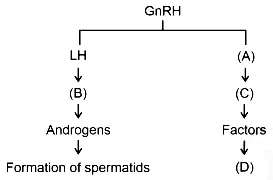
Identify the correct option (A), (B), (C), (D) with respect to spermatogenesis.
Correct Answer :
FSH, Leydig cells, Sertoli cells, spermiogenesis.
Solution :
Correct Option: FSH, Leydig cells, Sertoli cells, spermiogenesis.
Let us analyze the hormonal regulation scheme of spermatogenesis shown in the diagram step-by-step:
1. Regulation by GnRH:
Gonadotropin-Releasing Hormone (GnRH) is secreted by the hypothalamus. It acts on the anterior pituitary gland to stimulate the release of two gonadotropins:
• Luteinizing Hormone (LH), shown on the left branch of the flow chart.
• Follicle-Stimulating Hormone (FSH), represented by the label (A) on the right branch of the flow chart.
2. Action of Luteinizing Hormone (LH):
LH acts directly on the interstitial endocrine cells, known as the Leydig cells, represented by the label (B). Once stimulated, these cells synthesize and secrete male hormones called Androgens. These androgens then stimulate the pathways leading to the Formation of spermatids.
3. Action of Follicle-Stimulating Hormone (FSH):
FSH acts directly on the supporting cells in the testes, known as the Sertoli cells, represented by the label (C). These stimulated Sertoli cells secrete essential factors that assist in the process of spermiogenesis, represented by the label (D). Spermiogenesis is the specific stage where spherical, non-motile spermatids undergo structural transformation to become mature, flagellated, and motile spermatozoa (sperm cells).
Summary of the labels:
• (A) = FSH
• (B) = Leydig cells
• (C) = Sertoli cells
• (D) = spermiogenesis
Access expert-curated educational resources and study materials—completely free.
Create, conduct, and manage professional online assessments with Mindyard. Perfect for teachers and institutes.
Copyright © 2026 Mindyard. All Rights Reserved.
 Set - 3-1782888548748.webp)