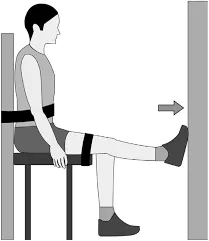
Identify the movement of the exercise shown in the picture given below:
Solution :
Correct Option: Isotonic ankle plantar flexion
To understand why this is the correct classification, let us break down the joint movement, body positioning, and contraction type shown in the image step-by-step:
1. Visual Details and Setup in the Image:
- The diagram shows a person sitting upright on a chair with stabilization straps secured around their waist and lower thigh. This stabilization ensures that the movement is isolated to the ankle joint rather than involving the hip or knee.
- The active leg is fully extended horizontally.
- A prominent grey arrow points horizontally forward, indicating the direction of force applied by the foot pressing against the vertical surface/plate.
2. Joint Movement (Plantar Flexion vs. Flexion/Dorsiflexion):
- Plantar flexion is the ankle movement where the foot points away from the shin (e.g., pressing down on a gas pedal). In the horizontal leg position shown, pushing the foot forward against the vertical plate requires plantar flexion.
- Ankle flexion (or dorsiflexion) would involve pulling the top of the foot backward toward the shin, which is the opposite direction of the arrow.
3. Contraction Type (Isotonic vs. Isometric):
- An isotonic contraction involves dynamic movement where the muscle changes length under a constant load, resulting in visible rotation at the joint.
- When performing this exercise dynamically against a resistance plate, the calf muscles (primarily the gastrocnemius and soleus) shorten to produce movement at the ankle, making it an isotonic contraction.
Combining these elements, the exercise depicted is Isotonic ankle plantar flexion.
Completely free for students. Educators & coaching institutes get 2 months free Pro trial to create tests.
Access unlimited practice questions, detailed step-by-step solutions, and exam study materials — completely free for students.
Create and conduct professional online assessments with AI question generation, tab proctoring, and comprehensive batch management.
A comprehensive CUET UG Mathematics Question Paper with Solutions – 2 June 2023 (Shift 3) designed to help students practice and understand the actual CUET exam pattern. This paper covers important topics from Algebra, Calculus, Coordinate Geometry, Probability, Statistics, Matrices, Determinants, and Vectors, featuring a balanced mix of conceptual, numerical, and application-based questions. Detailed solutions are provided to strengthen problem-solving skills, improve conceptual clarity, and enhance calculation accuracy. Based on the CUET syllabus and previous year exam trends, this paper is ideal for practice, revision, self-assessment, time management, previous year analysis, and final preparation for upcoming CUET UG Mathematics examinations.
A comprehensive CUET Accountancy Question Paper – 20 June 2023 (Shift 2) designed to help students practice and analyze previous year exam patterns for effective CUET preparation. This paper covers important topics including Accounting for Partnership Firms, Company Accounts, Financial Statements Analysis, Cash Flow Statements, Accounting Ratios, and Fundamental Accounting Principles. It features a balanced mix of conceptual, numerical, and application-based questions to strengthen accounting concepts, improve calculation accuracy, and enhance problem-solving skills. Based on the CUET exam structure and syllabus, this paper is ideal for practice, revision, self-assessment, time management, previous year analysis, and final preparation for upcoming CUET Accountancy examinations.
Copyright © 2026 Combe Labs Private Limited. All Rights Reserved.