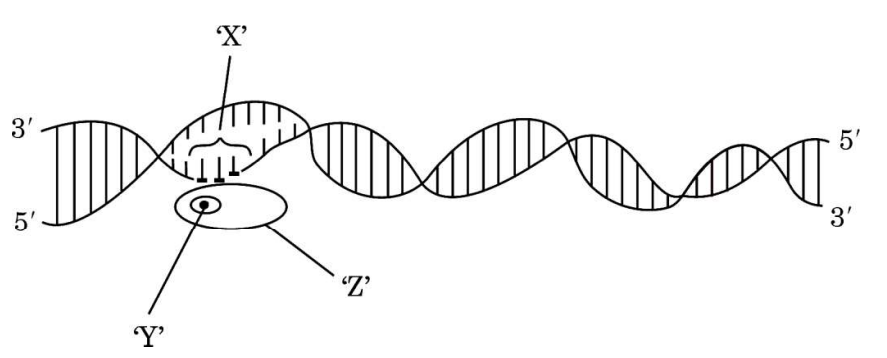
Identify the region 'X', the factor 'Y' and the enzyme 'Z' involved in the process of transcription in prokaryote as shown in the schematic representation given below.
Correct Answer :
Region 'X' - Promoter Factor 'Y' - Sigma (σ) Enzyme 'Z' - RNA polymerase
Solution :
The correct option is:
Region 'X' - Promoter
Factor 'Y' - Sigma ()
Enzyme 'Z' - RNA polymerase
Explanation:
Transcription is the process by which genetic information from a DNA template is copied into a complementary RNA sequence. In prokaryotes, this process consists of three major steps: initiation, elongation, and termination. The provided schematic representation illustrates the initiation stage of transcription.
Let's break down the components labeled in the diagram:
1. Region 'X' (Promoter): The label 'X' points to the specific region of the DNA double helix where the transcription machinery binds to start the process. This region is the promoter, which is a regulatory DNA sequence located upstream of the gene being transcribed.
2. Enzyme 'Z' (RNA polymerase): The large oval protein complex labeled 'Z' is RNA polymerase, the primary enzyme responsible for synthesizing RNA from the DNA template. In prokaryotes, a single core RNA polymerase is responsible for synthesizing all classes of RNA.
3. Factor 'Y' (Sigma factor, ): The core RNA polymerase enzyme alone cannot specifically bind to the promoter region. It requires the assistance of an initiation factor, labeled 'Y', which is the Sigma () factor. The binding of the sigma factor to the core enzyme forms the RNA polymerase holoenzyme, which specifically recognizes and binds to the promoter region 'X' to initiate transcription. Once the initiation phase is complete and elongation begins, the sigma factor dissociates from the enzyme complex.
Access expert-curated educational resources and study materials—completely free.
Create, conduct, and manage professional online assessments with Mindyard. Perfect for teachers and institutes.
Copyright © 2026 Mindyard. All Rights Reserved.
 Set - 3-1782888548748.webp)