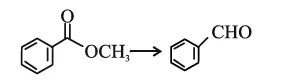
Identify the suitable reagent for the following conversion.
Correct Answer :
(i) AlH(iBu)2 (ii) H2O
(i) AlH(iBu)2, (ii) H2O
Solution :
The correct answer is (i) AlH(iBu)2, (ii) H2O.
Step-by-Step Explanation:
1. Identify the reactant and the product from the reaction scheme:
The given image shows the conversion of methyl benzoate () into benzaldehyde (). This is a selective reduction of an ester to an aldehyde.
2. Analyze the reaction behavior of each given reagent:
• followed by : Lithium aluminium hydride is a very strong reducing agent. It reduces esters completely to primary alcohols (in this case, yielding benzyl alcohol, ), rather than stopping at the aldehyde stage.
• followed by : Sodium borohydride is a mild reducing agent and is generally not reactive enough to reduce esters under standard conditions.
• : This reagent combination (Rosenmund catalyst) is used to reduce acid chlorides to aldehydes, but it does not reduce esters to aldehydes.
• (Diisobutylaluminium hydride, DIBAL-H) followed by : DIBAL-H is a selective, bulky reducing agent. When reacted with an ester at low temperatures (typically around -78 °C), it adds one equivalent of hydride to the carbonyl carbon to form a stable tetrahedral hemiacetal-like intermediate. This intermediate does not undergo further reduction. Subsequent acidic hydrolysis with water decomposes the intermediate to yield the target aldehyde (benzaldehyde).
Access expert-curated educational resources and study materials—completely free.
Create, conduct, and manage professional online assessments with Mindyard. Perfect for teachers and institutes.
Copyright © 2026 Mindyard. All Rights Reserved.