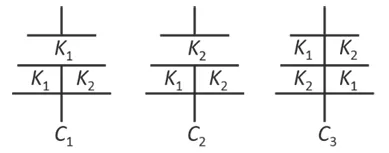
If K1 > K2 which condition for equivalent capacitance Ceq for the three configurations is correct?
Correct Answer :
C1 > C3 > C2
Solution :
The correct option is: C1 > C3 > C2
To find the correct relationship between the equivalent capacitances of the three configurations, let us define the base parameters of the capacitor. Let the total plate area be and the total distance between the parallel plates be . We define the capacitance of a vacuum-filled capacitor of area and thickness as:
Each configuration is split horizontally into two layers of equal thickness , and vertically into sections of area . Let us calculate the equivalent capacitance for each configuration step-by-step.
1. Configuration C1:
From the image, the top layer of is a single dielectric material of constant with thickness and area . Its capacitance is:
The bottom layer consists of two halves connected in parallel, each having area and thickness . The left half has dielectric and the right half has dielectric :
Since the top and bottom layers are connected in series, the reciprocal of the equivalent capacitance is:
2. Configuration C2:
In the second configuration, the top layer has a dielectric constant with thickness and area :
The bottom layer is identical to that of configuration :
These layers are in series, so the reciprocal of the equivalent capacitance is:
3. Configuration C3:
In the third configuration, the dielectric boundaries are continuous from top to bottom, dividing the capacitor into two parallel-connected columns of area :
- The left column has dielectric on top and at the bottom, in series:
- The right column has dielectric on top and at the bottom, in series, which is symmetrical to the left column:
Adding these parallel columns together gives the equivalent capacitance :
Taking the reciprocal to compare easily with the other configurations:
4. Direct Comparison under the condition K1 > K2:
First, comparing and :
Since , we have .
Adding to both sides yields:
Second, comparing and :
Subtracting from :
Since , we know that , which implies:
Thus,
Third, comparing and :
Subtracting from :
Since , we know that , which implies:
Thus,
Combining the inequalities, we get:
Access expert-curated educational resources and study materials—completely free.
Create, conduct, and manage professional online assessments with Mindyard. Perfect for teachers and institutes.
Copyright © 2026 Mindyard. All Rights Reserved.