
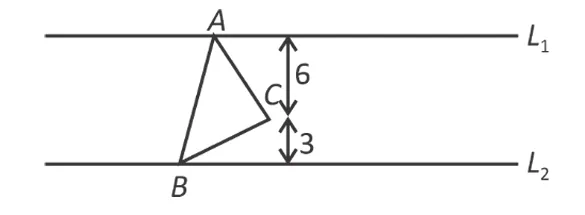
If L1 and L2 are two parallel lines and ΔABC is an equilateral triangle, then the area of triangle ABC is
Solution :
The correct answer is 21√3.
Step-by-Step Explanation:
Let us analyze the details from the provided image:
1. We are given two parallel lines, L1 (top line) and L2 (bottom line).
2. Vertex A of the equilateral triangle ΔABC lies on line L1, and vertex B lies on line L2.
3. The vertical distance from line L1 (and thus from vertex A) to vertex C is labeled as 6.
4. The vertical distance from vertex C to line L2 is labeled as 3.
5. Therefore, the total vertical distance between line L1 and line L2 is:
Let be the side length of the equilateral triangle ΔABC.
Let be the angle that the side AB makes with the horizontal line L2.
Since A lies on L1 and B lies on L2, the vertical height of A relative to B is 9. Thus, we have:
Similarly, let be the angle that the side AC makes with the horizontal.
Since the vertical distance from A to C is 6, we have:
Since ΔABC is an equilateral triangle, the angle between the sides AB and AC is 60°.
Therefore, the difference between the angles they make with the horizontal is 60°:
Taking the cosine of both sides:
Using the trigonometric identity:
We can express and in terms of :
Substituting these values into our identity:
Multiplying both sides by :
Squaring both sides:
Subtracting 2916 from both sides:
Multiplying by 4:
Rearranging the terms:
Since , dividing both sides by gives:
The area of an equilateral triangle with side length is given by:
Substituting into the area formula:
Completely free for students. Educators & coaching institutes get 2 months free Pro trial to create tests.
Access unlimited practice questions, detailed step-by-step solutions, and exam study materials — completely free for students.
Create and conduct professional online assessments with AI question generation, tab proctoring, and comprehensive batch management.

A comprehensive JEE Advanced 2022 Paper 1 designed to help aspirants understand the examination pattern, difficulty level, and question trends of JEE Advanced. This paper covers important concepts from Physics, Chemistry, and Mathematics, featuring a balanced mix of conceptual, numerical, and advanced application-based questions. It helps students strengthen conceptual understanding, enhance analytical and problem-solving skills, and improve speed and accuracy. Ideal for practice, revision, self-assessment, previous year trend analysis, concept reinforcement, and time management, this paper is a valuable resource for effective JEE Advanced preparation.

A comprehensive JEE Advanced 2022 Paper 2 designed to help aspirants understand the examination pattern, difficulty level, and question trends of JEE Advanced. This paper covers important concepts from Physics, Chemistry, and Mathematics, featuring a balanced mix of conceptual, numerical, and advanced application-based questions. It helps students strengthen conceptual understanding, enhance analytical and problem-solving skills, and improve speed and accuracy. Ideal for practice, revision, self-assessment, previous year trend analysis, concept reinforcement, and time management, this paper is a valuable resource for effective JEE Advanced preparation.
Copyright © 2026 Combe Labs Private Limited. All Rights Reserved.


