If y is the solution of the differential equation 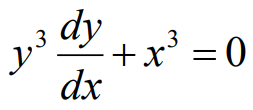 , y(0)=1, the value of y(-1) is
Correct Answer :
0
Solution :
Correct Answer: 0
Step-by-step Explanation:
By analyzing the provided image, we can identify the first-order ordinary differential equation written on the screen as:
We are given the initial condition , and we need to find the value of .
Step 1: Separate the variables
We rearrange the differential equation to group all terms containing on one side and all terms containing on the other side:
Multiplying both sides by , we obtain the separated form:
Step 2: Integrate both sides
Now, we integrate both sides of the equation to find the general solution:
Using the power rule for integration, , we get:
where is the constant of integration. Multiplying the entire equation by 4 gives:
where is an arbitrary constant. Rearranging terms, we have:
Step 3: Solve for the constant K using the initial condition
We are given that , meaning when . Substituting these values into our equation:
Thus, the particular solution of the differential equation is:
Step 4: Find the value of y(-1)
To determine , we substitute into the particular solution:
Since , the equation simplifies to:
Subtracting 1 from both sides:
Taking the fourth root of both sides gives:
Therefore, the value of is 0.
Access expert-curated educational resources and study materials—completely free.
Create, conduct, and manage professional online assessments with Mindyard. Perfect for teachers and institutes.
Copyright © 2026 Mindyard. All Rights Reserved.