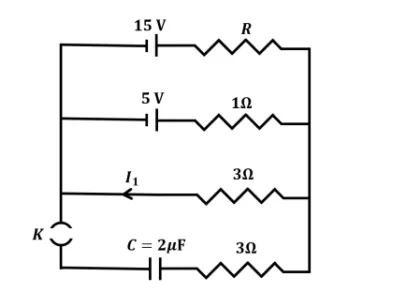
In a circuit shown in the figure, the capacitor C is initially uncharged and the key K is open. In this condition, a current of 1 A flows through the 1 Ω resistor. The key is closed at time t = t0. Which of the following statement(s) is(are) correct?
[Given: e−1 = 0.36]
Correct Answer :
The value of the resistance R is 3 Ω.
For t < t0, the value of current I1 is 2 A.
At t = t0 + 7.2 μs, the current in the capacitor is 0.6 A.
For t → ∞, the charge on the capacitor is 12 μC.
Solution :
Correct Answer: All four statements are correct:
• The value of the resistance R is 3 Ω.
• For t < t0, the value of current I1 is 2 A.
• At t = t0 + 7.2 μs, the current in the capacitor is 0.6 A.
• For t → ∞, the charge on the capacitor is 12 μC.
Step 1: Circuit analysis for t < t0 (Key K is OPEN)
When key K is open, no current flows through the bottom-most branch containing capacitor C = 2 μF and the 3 Ω resistor. Therefore, the circuit effectively consists of three parallel branches:
1. Top branch: Battery of 15 V with resistance R.
2. Middle-1 branch: Battery of 5 V with resistor 1 Ω.
3. Middle-2 branch: Resistor 3 Ω carrying current I1.
Let the potential of the common right node be 0 V, and let the potential of the common left node (before key K) be VA.
Using Nodal Analysis at node A:
We are given that the current through the 1 Ω resistor is 1 A. Current flows from the 5 V source towards node A through the 1 Ω resistor, so:
Now, substituting VA = 6 V into our nodal equation:
The current I1 flowing through the 3 Ω resistor is:
Thus, statements 1 and 2 are correct.
Step 2: Circuit analysis after closing Key K at t = t0
To analyze the charging of the capacitor, we convert the network connected across the capacitor branch (between node A and the right node) into its Thévenin Equivalent Circuit.
1. Thévenin Equivalent Voltage (Vth):
The open-circuit potential difference across node A and the right node when no current flows into the capacitor branch is:
2. Thévenin Equivalent Resistance (Rth):
Deactivating independent voltage sources gives three parallel resistors: R = 3 Ω, 1 Ω, and 3 Ω.
The total resistance connected in series with the capacitor C = 2 μF is:
Step 3: Calculating Time Constant (τ)
Step 4: Current in the capacitor at t = t0 + 7.2 μs
The initial current in the capacitor at t = t0+ (since initially uncharged, VC = 0):
The charging current decay equation is:
At t = t0 + 7.2 μs (which corresponds to t - t0 = τ):
Thus, statement 3 is correct.
Step 5: Charge on the capacitor for t → ∞
In steady-state (t → ∞), the capacitor is fully charged and acts as an open circuit. The voltage across the capacitor equals the Thévenin voltage Vth = 6 V.
Thus, statement 4 is also correct.
Access expert-curated educational resources and study materials—completely free.
Create, conduct, and manage professional online assessments with Mindyard. Perfect for teachers and institutes.
Copyright © 2026 Mindyard. All Rights Reserved.