In a furnace, the inner and outer sides of the brick wall (k1 = 2.5 W/mK) are maintained at 1100°C and 700°C respectively as shown in figure.
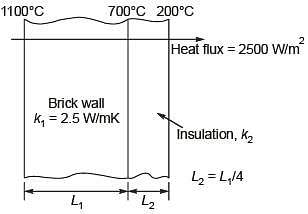
The brick wall is covered by an insulating material of thermal conductivity k2. The thickness of the insulation is 1/4th of the thickness of the brick wall. The outer surface of the insulation is at 200°C. The heat flux through the composite walls is 2500 W/m2. The value of k2 is ________ W/mK (round off to 2 decimal places).
Correct Answer :
Correct answer is : 0.5
For brick wall, k1 = 2.5 W/m.k, dT1 = 700 – 1100 = -400 K
For Insulation, dT2 = 200 – 700 = -500 K and L2 = L1/4
Since the heat flux through the wall remains same,
Solution :
The correct answer is 0.5.
Step-by-step Explanation:
Based on the provided schematic diagram of the furnace wall, we can observe the following labels, data points, and configuration:
1. A composite wall consisting of a Brick wall of thickness and thermal conductivity adjacent to an Insulation layer of thickness and thermal conductivity .
2. The boundary temperatures are maintained at on the inner side, at the brick-insulation interface, and on the outer side of the insulation.
3. The thickness relationship is given by the equation:
4. Under steady-state conditions, a uniform heat flux passes through both walls:
Applying Fourier's Law of Heat Conduction:
Under steady-state conditions, the rate of heat transfer per unit area (heat flux, ) is constant through both sections of the composite wall. Therefore, we can equate the heat flux through the brick wall to the heat flux through the insulation material:
Where:
- For the brick wall:
- For the insulating layer:
Substituting the Parameters and Solving:
We substitute and the respective values into the heat flux relation:
This can be simplified by cancelling from the denominators of both sides:
Substituting the known constants (, , and ):
Thus, the thermal conductivity of the insulation, , is 0.5 W/mK.
Access expert-curated educational resources and study materials—completely free.
Create, conduct, and manage professional online assessments with Mindyard. Perfect for teachers and institutes.
Copyright © 2026 Mindyard. All Rights Reserved.