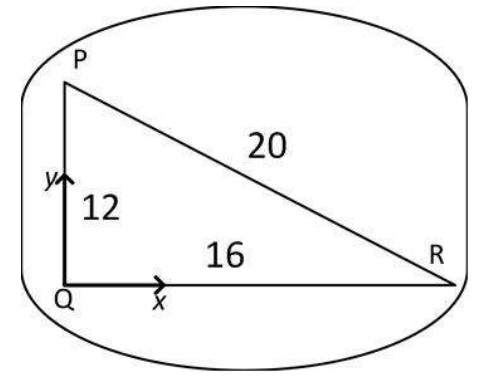
In a rigid body in plane motion, the point R is accelerating with respect to point P at 10∠180° m/s2 . If the instantaneous acceleration of point Q is zero, the acceleration (in m/s2 ) of point R is
Correct Answer :
8∠217°
Solution :
The correct option is 8∠217°.
1. Coordinate System Setup and Geometry:
From the given image, we can establish a Cartesian coordinate system with the origin at point Q(0, 0).
- The point P is located along the vertical y-axis at a distance of 12 units:
- The point R is located along the horizontal x-axis at a distance of 16 units:
- Therefore, the position vector of R relative to P is:
2. Relative Acceleration Relationship:
For a rigid body in plane motion, the acceleration of point R relative to point P is given by:
where:
- is the angular acceleration vector.
- is the angular velocity of the rigid body.
Let's compute the cross product term:
Now, compute the centripetal acceleration term:
Combining these gives the relative acceleration vector:
3. Solving for Angular Motion Parameters:
We are given that the relative acceleration is:
Equating the components:
(Equation 1)
(Equation 2)
From Equation 2, we can express in terms of :
Substituting this into Equation 1:
Then, solving for :
4. Acceleration of Point R:
We are given that the instantaneous acceleration of point Q is zero (). Therefore, the acceleration of R is simply:
Since :
Substituting and :
5. Magnitude and Direction of aR:
- Magnitude:
- Angle with the positive x-axis (since both components are negative, the vector lies in the third quadrant):
Therefore, the acceleration of point R is 8∠217°.
Access expert-curated educational resources and study materials—completely free.
Create, conduct, and manage professional online assessments with Mindyard. Perfect for teachers and institutes.
Copyright © 2026 Mindyard. All Rights Reserved.