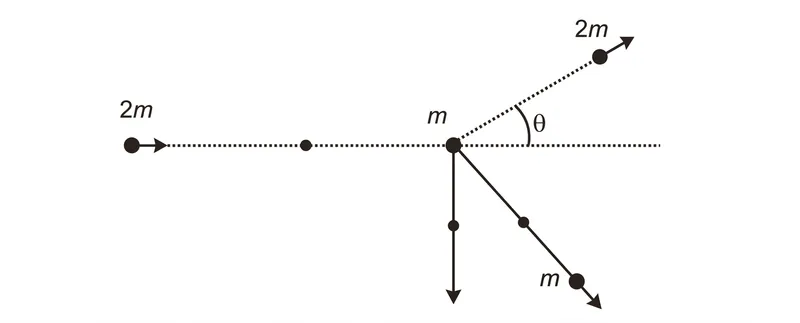
In a scattering experiment, a particle of mass 2m collides with another particle of mass m, which is initially at rest. Assuming the collision to be perfectly elastic, the maximum angular deviation θ of the heavier particle, as shown in the figure, in radians is:
Correct Answer :
π/6
Solution :
Correct Option: The correct answer is .
Analysis of the Figure:
As shown in the provided schematic diagram, a projectile particle of mass moves horizontally to the right with an initial velocity and collides with a target particle of mass that is initially at rest. After the collision, the heavier particle of mass is scattered upwards at an angle relative to its original line of motion, while the lighter particle of mass moves downwards and to the right.
Step-by-Step Mathematical Derivation:
Let the initial velocity of the heavier particle () be , and let the target particle () be initially at rest ().
After the elastic collision, let the velocity of the heavier particle be at an angle above the horizontal, and the velocity of the lighter particle be at an angle below the horizontal.
1. Conservation of Linear Momentum
Along the horizontal direction (x-axis):
Substituting and :
--- (Equation 1)
Along the vertical direction (y-axis):
Substituting and :
--- (Equation 2)
To eliminate the angle , we square and add Equation 1 and Equation 2:
--- (Equation 3)
2. Conservation of Kinetic Energy (Perfectly Elastic Collision)
Substituting the mass values:
--- (Equation 4)
3. Combining Equations to Solve for the Angle
Equating the expressions for from Equation 3 and Equation 4:
Dividing the entire equation by 2 gives:
This is a quadratic equation in terms of . Since the final speed must be a real physical quantity, the discriminant () of this quadratic equation must be greater than or equal to zero:
Since , we can divide by :
Taking the square root for the acute scattering angle :
Since decreases as increases from 0 to , this inequality translates directly to:
Thus, the maximum possible angular deviation of the heavier particle is:
Access expert-curated educational resources and study materials—completely free.
Create, conduct, and manage professional online assessments with Mindyard. Perfect for teachers and institutes.
Copyright © 2026 Mindyard. All Rights Reserved.