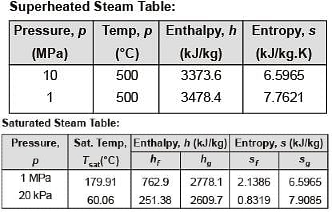
In a steam power plant, superheated steam at 10 MPa and 500°C, is expanded isentropically in a turbine until it becomes a saturated vapour. It is then reheated at constant pressure to 500°C. The steam is next expanded isentropically in another turbine until it reaches the condenser pressure of 20 kPa. Relevant properties of steam are given in the following two tables. The work done by both the turbines together is ______ kJ/kg (roundoff to the nearest integer).
Correct Answer :
Correct answer is : 1513
Solution :
The correct answer is 1513.
Step-by-step Explanation:
We are given a reheat Rankine cycle with the following stages:
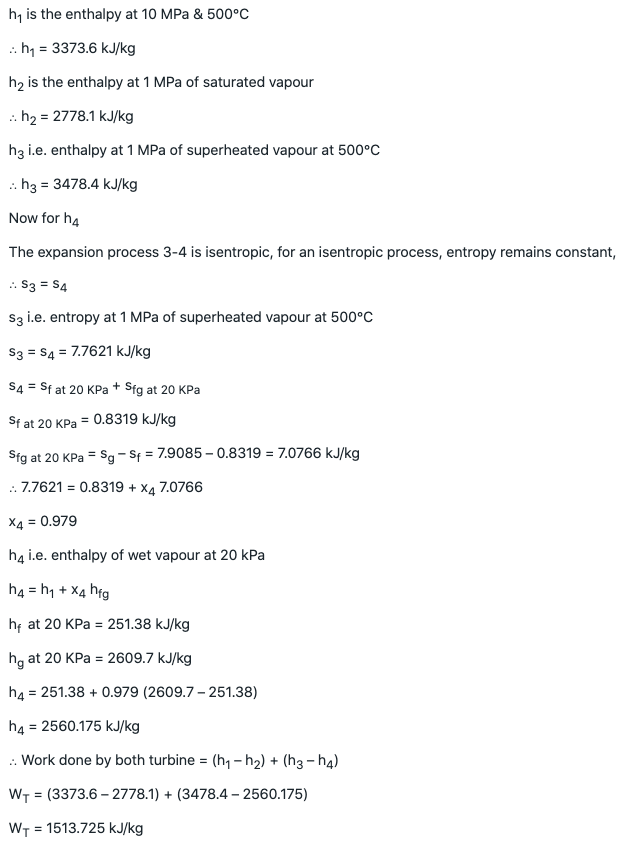
1. State 1: Superheated steam at and enters the high-pressure (HP) turbine.
2. State 2: Steam is expanded isentropically in the HP turbine to a pressure until it becomes a saturated vapour ().
3. State 3: The steam is reheated at constant pressure () to .
4. State 4: The steam is expanded isentropically in the low-pressure (LP) turbine to the condenser pressure .
Step 1: Determine properties at State 1 (Turbine 1 Inlet)
From the Superheated Steam Table at and :
Step 2: Determine properties at State 2 (Turbine 1 Outlet / Reheater Inlet)
Since the expansion in the first turbine is isentropic:
We are given that at State 2, the steam becomes a saturated vapour. Therefore, the entropy of the saturated vapour at this pressure must equal :
Looking at the Saturated Steam Table, the pressure at which is . Thus, the reheat pressure is:
At this state, the enthalpy is that of saturated vapour at :
Step 3: Determine properties at State 3 (Turbine 2 Inlet)
The steam is reheated at constant pressure of to .
From the Superheated Steam Table at and :
Step 4: Determine properties at State 4 (Turbine 2 Outlet)
The expansion in the second turbine is isentropic:
At the condenser pressure , we check the saturation properties from the Saturated Steam Table:
Since , State 4 lies in the wet region. We calculate the dryness fraction ():
Now, we calculate the enthalpy at State 4 () using the saturation enthalpies at ( and ):
Step 5: Calculate total work done by both turbines
The total turbine work output () is the sum of the work done by the HP and LP turbines:
Rounding to the nearest integer, we get:
Access expert-curated educational resources and study materials—completely free.
Create, conduct, and manage professional online assessments with Mindyard. Perfect for teachers and institutes.
Copyright © 2026 Mindyard. All Rights Reserved.