Correct Answer :
Solution :
The correct answer is 1.2.
Step-by-Step Explanation:
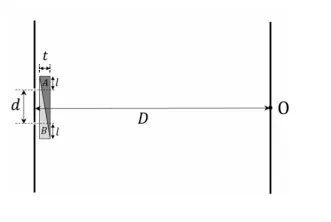
First, let us analyze the geometry of the double-slit setup and the glass wedge combination shown in the figure.
The total height of the rectangular combination of the wedges is:
Given values:
Therefore, the total vertical height of the wedge block is:
Let the bottom of the wedge combination be at and the top be at .
The upper slit, , is located at a distance from the top of the block. Thus, its position from the bottom is:
The lower slit, , is located at a distance from the bottom of the block, so:
Let us determine the thickness of each wedge at the positions of the two slits. The thickness of wedge A (having refractive index ) decreases linearly from at the top () to at the bottom (). The thickness of wedge B (having refractive index ) increases linearly from at the top () to at the bottom ().
Thus, the thickness of wedge A at height is given by:
And the thickness of wedge B at height is given by:
At the upper slit (, where ):
At the lower slit ():
The optical path length for the ray passing through in the glass block is:
The optical path length for the ray passing through in the glass block is:
Therefore, the optical path difference introduced between the two rays by the wedges is:
Since the optical path is larger for the ray passing through the upper slit , the central maximum shifts upward towards .
The relation for the shift of the central maximum is given by:
Substituting the given values:
Now, calculate the shift:
Thus, the shift of the central maximum with respect to point is 1.2 mm.
Access expert-curated educational resources and study materials—completely free.
Create, conduct, and manage professional online assessments with Mindyard. Perfect for teachers and institutes.
Copyright © 2026 Mindyard. All Rights Reserved.