
In a Young's double slit experiment, each of the two slits A and B , as shown in the figure, are oscillating about their fixed center and with a mean separation of 0.8mm . The distance between the slits at time t is given by d = (0.8 + 0.04 sin ωt)mm , where ω = 0.08 rads−1 . The distance of the screen from the slits is 1m and the wavelength of the light used to illuminate the slits is 6000 0 A . The interference pattern on the screen changes with time, while the central bright fringe (zeroth fringe) remains fixed at point O.
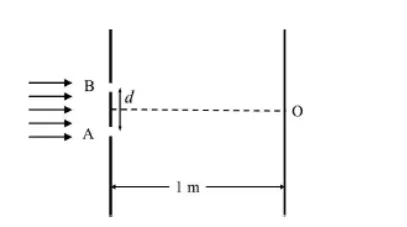
Question : The maximum speed in μm/s at which the 8 th bright fringe will move is
Solution :
The correct answer is 24.
Step-by-Step Explanation:
1. Understanding the given parameters:
From the problem text and the diagram showing two slits A and B separated by a distance with screen distance and central point on the screen:
Distance between the slits at time :
Angular frequency:
Distance to the screen:
Wavelength of light:
2. Position of the 8th bright fringe:
In Young's double slit experiment, the position of the th bright fringe from the central zeroth fringe is given by:
For the th bright fringe ():
3. Speed of the 8th bright fringe:
Differentiating with respect to time gives the instantaneous speed :
From the given equation for :
Thus, the magnitude of speed is:
4. Calculating the maximum speed:
The maximum speed occurs when and is minimum () or approximated around mean distance for small oscillations. Using :
Simplifying step by step:
Converting to :
Thus, the maximum speed of the 8th bright fringe is 24 μm/s.
Completely free for students. Educators & coaching institutes get 2 months free Pro trial to create tests.
Access unlimited practice questions, detailed step-by-step solutions, and exam study materials — completely free for students.
Create and conduct professional online assessments with AI question generation, tab proctoring, and comprehensive batch management.

A comprehensive JEE Advanced 2022 Paper 1 designed to help aspirants understand the examination pattern, difficulty level, and question trends of JEE Advanced. This paper covers important concepts from Physics, Chemistry, and Mathematics, featuring a balanced mix of conceptual, numerical, and advanced application-based questions. It helps students strengthen conceptual understanding, enhance analytical and problem-solving skills, and improve speed and accuracy. Ideal for practice, revision, self-assessment, previous year trend analysis, concept reinforcement, and time management, this paper is a valuable resource for effective JEE Advanced preparation.

A comprehensive JEE Advanced 2022 Paper 2 designed to help aspirants understand the examination pattern, difficulty level, and question trends of JEE Advanced. This paper covers important concepts from Physics, Chemistry, and Mathematics, featuring a balanced mix of conceptual, numerical, and advanced application-based questions. It helps students strengthen conceptual understanding, enhance analytical and problem-solving skills, and improve speed and accuracy. Ideal for practice, revision, self-assessment, previous year trend analysis, concept reinforcement, and time management, this paper is a valuable resource for effective JEE Advanced preparation.
Copyright © 2026 Combe Labs Private Limited. All Rights Reserved.


