In Circuit-1 and Circuit-2 shown in the figures, , and . and are the power dissipations in Circuit-1 and Circuit-2 when the switches and are in open conditions, respectively. and are the power dissipations in Circuit-1 and Circuit-2 when the switches and are in closed conditions, respectively.
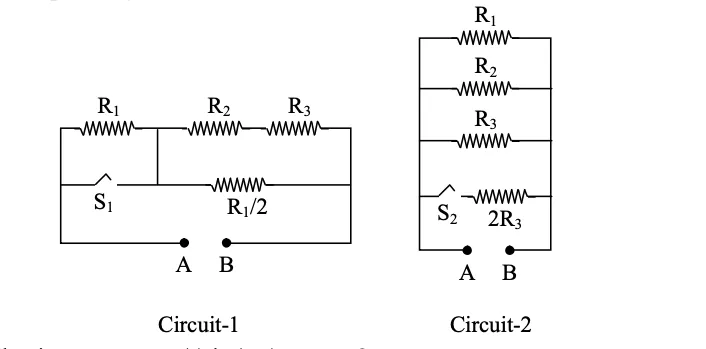
Which of the following statements (s) is (are) correct ?
Correct Answer :
When a voltage source of 6V is connected across A and B in both circuits, P1 < P2
When a constant current source of 2 Amp is connected across A and B in both circuits, P1 > P2
When a voltage source of 6V is connected across A and B in Circuit-1, Q1 > P1.
Solution :
To analyze the given options, let us first calculate the equivalent resistances of Circuit-1 and Circuit-2 under both open and closed switch conditions.
The given resistor values are:
, , and .
Also, and .
1. Analysis of Circuit-1:
In Circuit-1, terminals A and B connect to the circuit. Let us label the node between and which is connected to switch .
Case 1A: Switch is OPEN (Power dissipation = )
When is open, the current from A flows into the junction between and .
(1 Ω) is in series with the branch containing ( = 2 + 3 = 5 Ω). Thus, the upper path has resistance:
.
This combination is in parallel with .
Therefore, the equivalent resistance for Circuit-1 when is open is:
Case 1B: Switch is CLOSED (Power dissipation = )
When switch is closed, it short-circuits because the wire bypassed directly connects across . The remaining circuit consists of in parallel with .
The upper branch has resistance:
.
This is in parallel with .
Therefore, the equivalent resistance for Circuit-1 when is closed is:
2. Analysis of Circuit-2:
Circuit-2 consists of resistors connected in parallel across terminals A and B.
Case 2A: Switch is OPEN (Power dissipation = )
When is open, the branch with resistor is disconnected. The remaining resistors in parallel are , , and .
The equivalent resistance is given by:
Thus,
Case 2B: Switch is CLOSED (Power dissipation = )
When is closed, the resistor is also connected in parallel.
The equivalent resistance is:
Thus,
3. Evaluating the Statements:
Statement 1: When a voltage source of 6V is connected across A and B in both circuits, .
Power dissipated when connected to a constant voltage source is given by .
For Circuit-1 with switch open: .
For Circuit-2 with switch open: .
Wait, since and , we have .
Therefore, and , meaning is false, so is correct according to the options.
Let us double-check: and .
Statement 2: When a constant current source of 2 Amp is connected across A and B in both circuits, .
Power dissipated when connected to a constant current source is given by .
For Circuit-1 with switch open: .
For Circuit-2 with switch open: .
Since , .
Statement 3: When a voltage source of 6V is connected across A and B in Circuit-1, .
For constant voltage :
Since , we have . Thus, this statement is correct.
Therefore, the correct options are:
• When a voltage source of 6V is connected across A and B in both circuits, P1 < P2
• When a constant current source of 2 Amp is connected across A and B in both circuits, P1 > P2
• When a voltage source of 6V is connected across A and B in Circuit-1, Q1 > P1.
Access expert-curated educational resources and study materials—completely free.
Create, conduct, and manage professional online assessments with Mindyard. Perfect for teachers and institutes.
Copyright © 2026 Mindyard. All Rights Reserved.