
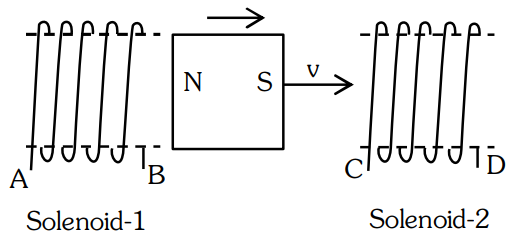
In the above diagram, a strong bar magnet is moving towards solenoid-2 from solenoid-1. The direction of induced current in solenoid-1 and that in solenoid-2, respectively, are through the directions:
Solution :
The correct option is AB and DC.
To determine the direction of the induced current in both solenoids, we use Lenz's Law. Lenz's law states that the direction of the induced current in a closed circuit is such that the magnetic field created by the induced current opposes the change in the magnetic flux that produced it.
1. Induced Current in Solenoid-1:
- The bar magnet is moving to the right, which means its North pole () is moving away from the right end of Solenoid-1.
- To oppose this motion, Solenoid-1 will try to attract the receding North pole. Therefore, the right end of Solenoid-1 must behave as a South pole ().
- According to the clock rule, when viewed from the right end, the current must flow in a clockwise direction to form a South pole.
- In the diagram, the front windings of Solenoid-1 (represented by the solid lines) go from bottom to top. For a viewer on the right, the front of the solenoid is on the left side of their field of view. A clockwise current must flow upwards on this front side (left) and downwards on the back side (right).
- Since the current flows upwards on the front visible wires, it travels from terminal A to B.
2. Induced Current in Solenoid-2:
- The bar magnet is moving to the right, which means its South pole () is approaching the left end of Solenoid-2.
- To oppose this approaching South pole, Solenoid-2 will try to repel it. Therefore, the left end of Solenoid-2 must behave as a South pole ().
- When viewed from the left end, the current must flow in a clockwise direction to form a South pole.
- For a viewer on the left, the front of the solenoid (solid lines) is on the right side of their field of view. A clockwise current must flow downwards on this front side (right) and upwards on the back side (left).
- Since the current flows downwards on the front visible wires, it travels from terminal D to C.
Thus, the directions of the induced currents in Solenoid-1 and Solenoid-2 are AB and DC respectively.
Completely free for students. Educators & coaching institutes get 2 months free Pro trial to create tests.
Access unlimited practice questions, detailed step-by-step solutions, and exam study materials — completely free for students.
Create and conduct professional online assessments with AI question generation, tab proctoring, and comprehensive batch management.

A comprehensive JEE Advanced 2022 Paper 1 designed to help aspirants understand the examination pattern, difficulty level, and question trends of JEE Advanced. This paper covers important concepts from Physics, Chemistry, and Mathematics, featuring a balanced mix of conceptual, numerical, and advanced application-based questions. It helps students strengthen conceptual understanding, enhance analytical and problem-solving skills, and improve speed and accuracy. Ideal for practice, revision, self-assessment, previous year trend analysis, concept reinforcement, and time management, this paper is a valuable resource for effective JEE Advanced preparation.

A comprehensive JEE Advanced 2022 Paper 2 designed to help aspirants understand the examination pattern, difficulty level, and question trends of JEE Advanced. This paper covers important concepts from Physics, Chemistry, and Mathematics, featuring a balanced mix of conceptual, numerical, and advanced application-based questions. It helps students strengthen conceptual understanding, enhance analytical and problem-solving skills, and improve speed and accuracy. Ideal for practice, revision, self-assessment, previous year trend analysis, concept reinforcement, and time management, this paper is a valuable resource for effective JEE Advanced preparation.
Copyright © 2026 Combe Labs Private Limited. All Rights Reserved.


