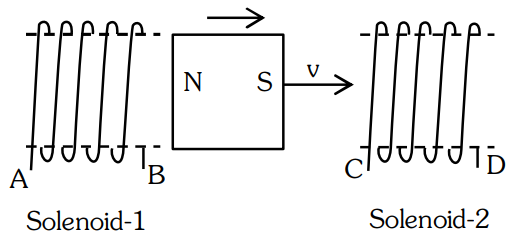
In the above diagrams, a strong bar magnet is moving towards solenoid-2 from solenoid-1. The direction of induced current in solenoid-1 and that in solenoid-2, respectively, are through the directions :
Solution :
When a magnet moves relative to a coil, an electromotive force (EMF) is induced in the coil according to Faraday’s law. The direction of the induced current is given by Lenz’s law: the induced magnetic field always opposes the change that produced it.
In the given diagram (see the attached image), the two solenoids are labeled with their terminals:
The bar magnet is moving **towards** solenoid‑2 while it is still positioned near solenoid‑1. As the north pole of the magnet approaches solenoid‑2, the magnetic flux through solenoid‑2 increases in the direction of the magnet’s field (from left to right in the picture).
indicates that the flux through solenoid‑2 is increasing. Lenz’s law tells us that the induced current in solenoid‑2 must create a magnetic field that opposes this increase, i.e., a field pointing **away** from the approaching north pole. To generate such a field, the current must flow from terminal D to terminal C. Hence the induced current direction in solenoid‑2 is **D → C**.
At the same time, the magnet’s motion also changes the flux through solenoid‑1, but in the opposite sense: the north pole moving away from solenoid‑1 reduces the magnetic field threading it.
shows a decreasing flux through solenoid‑1. To oppose this decrease, solenoid‑1 must produce a magnetic field that **adds** to the original field, i.e., a field pointing toward the magnet (to the right). This requires a current that flows from terminal A to terminal B. Therefore, the induced current direction in solenoid‑1 is **A → B**.
Combining both results, the induced currents are:
Thus the correct pair of directions is AB and DC, which matches the provided answer.
Completely free for students. Educators & coaching institutes get 2 months free Pro trial to create tests.
Access unlimited practice questions, detailed step-by-step solutions, and exam study materials — completely free for students.
Create and conduct professional online assessments with AI question generation, tab proctoring, and comprehensive batch management.

A comprehensive JEE Advanced 2022 Paper 1 designed to help aspirants understand the examination pattern, difficulty level, and question trends of JEE Advanced. This paper covers important concepts from Physics, Chemistry, and Mathematics, featuring a balanced mix of conceptual, numerical, and advanced application-based questions. It helps students strengthen conceptual understanding, enhance analytical and problem-solving skills, and improve speed and accuracy. Ideal for practice, revision, self-assessment, previous year trend analysis, concept reinforcement, and time management, this paper is a valuable resource for effective JEE Advanced preparation.

A comprehensive JEE Advanced 2022 Paper 2 designed to help aspirants understand the examination pattern, difficulty level, and question trends of JEE Advanced. This paper covers important concepts from Physics, Chemistry, and Mathematics, featuring a balanced mix of conceptual, numerical, and advanced application-based questions. It helps students strengthen conceptual understanding, enhance analytical and problem-solving skills, and improve speed and accuracy. Ideal for practice, revision, self-assessment, previous year trend analysis, concept reinforcement, and time management, this paper is a valuable resource for effective JEE Advanced preparation.
Copyright © 2026 Combe Labs Private Limited. All Rights Reserved.