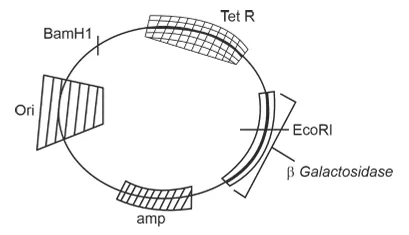
In the above represented plasmid an alien piece of DNA is inserted at EcoRI site. Which of the following strategies will be chosen to select the recombinant colonies?
Correct Answer :
White color colonies will be selected.
Solution :
The correct answer is: White color colonies will be selected.
Step-by-Step Explanation:
1. Analysis of the Plasmid Diagram:
According to the provided image of the plasmid, the vector contains:
• An origin of replication (Ori).
• Marker genes conferring resistance to ampicillin (amp) and tetracycline (Tet R).
• A restriction cleavage site for BamH1.
• A restriction cleavage site for EcoRI that is located directly within the coding sequence of the β-Galactosidase enzyme.
2. Principle of Insertional Inactivation:
When a foreign/alien piece of DNA is inserted at the EcoRI restriction site, the coding sequence of the β-Galactosidase gene is disrupted and split. This disruption inactivates the gene, rendering it incapable of producing a functional β-galactosidase enzyme. This phenomenon is known as insertional inactivation.
3. Selection of Recombinant Colonies:
The difference in enzyme activity allows for a simple color-based screening when grown on a medium containing a chromogenic substrate (such as X-gal):
• Non-recombinants: The β-galactosidase gene remains intact, producing a functional enzyme that breaks down the chromogenic substrate, turning the colonies blue.
• Recombinants: The β-galactosidase gene is inactivated by the inserted DNA, so no active enzyme is made. The chromogenic substrate remains intact, leaving the colonies white (colorless).
Thus, the recombinant colonies are easily selected because they form white color colonies.
Access expert-curated educational resources and study materials—completely free.
Create, conduct, and manage professional online assessments with Mindyard. Perfect for teachers and institutes.
Copyright © 2026 Mindyard. All Rights Reserved.
 Set - 3-1782888548748.webp)