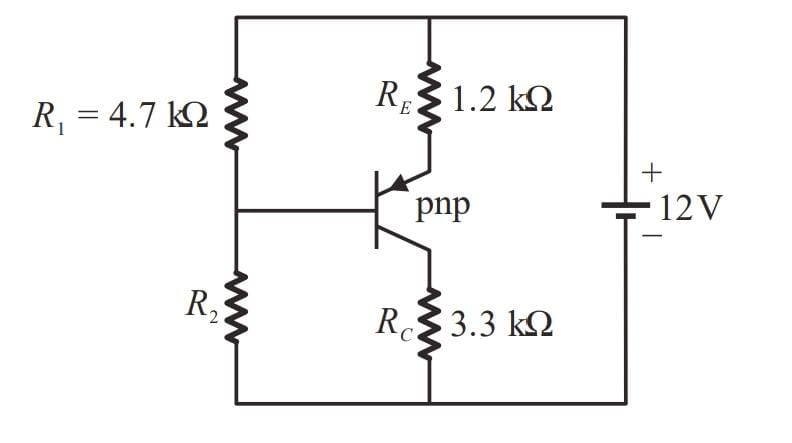
In the BJT circuit shown, beta of the PNP transistor is 100. Assume VBE =−0.7V. The voltage across RC will be 5 V when R2 is ________ kΩ . (Round off to 2 decimal places)
Correct Answer :
Solution :
The correct answer is 18.099.
Given parameters from the circuit diagram:
Supply voltage,
Base resistor,
Emitter resistor,
Collector resistor,
Transistor current gain,
Base-emitter voltage, (which implies )
Voltage across collector resistor,
Step 1: Calculate the Collector Current ()
Using Ohm's law across the collector resistor :
Step 2: Calculate the Base Current () and Emitter Current ()
The base current is related to the collector current by:
+
Step 3: Calculate the Emitter Voltage () and Base Voltage ()
The emitter terminal is connected to the supply rail via :
Step 4: Solve for the Voltage-Divider Resistor ()
Applying Kirchhoff's Current Law (KCL) at the base node:
Access expert-curated educational resources and study materials—completely free.
Create, conduct, and manage professional online assessments with Mindyard. Perfect for teachers and institutes.
Copyright © 2026 Mindyard. All Rights Reserved.