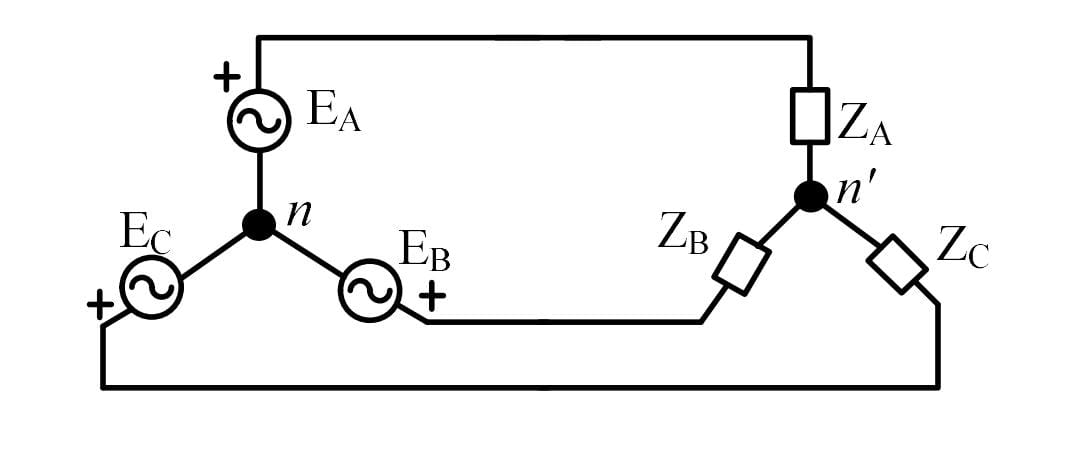
In the circuit shown below, a three-phase star-connected unbalanced load is connected to a balanced threephase supply of 100√3 V with phase sequence ABC.
The star connected load has ZA = 10Ω and ZB =20∠60°Ω. The value of ZC in Ω , for which the voltage difference across the nodes n and n' is zero, is
Correct Answer :
20∠-60°
Solution :
The correct answer is 20∠-60°.
To find the value of for which the voltage difference between the neutral node of the supply () and the neutral node of the load () is zero, we can apply Millman's Theorem to the three-phase star-star circuit shown below:
From the diagram, the balanced three-phase supply has phase voltages , , and connected at supply neutral node . The star-connected load has impedances , , and meeting at load neutral node .
Since the supply is balanced with a phase sequence of ABC, the phase voltages (taking phase A as the reference) are represented as:
The voltage difference across the nodes and , denoted as , is given by Millman's Theorem:
where the branch admittances are:
, , and .
For the voltage difference to be zero (), the numerator of the expression must equal zero:
Given values:
Substituting the phase voltages and admittances into the balance equation:
Dividing the entire equation by the common factor :
Converting the terms to rectangular form:
So, the sum of the first two terms is:
Substituting this back into the equation:
Solving for the admittance :
Finally, we calculate the load impedance :
Access expert-curated educational resources and study materials—completely free.
Create, conduct, and manage professional online assessments with Mindyard. Perfect for teachers and institutes.
Copyright © 2026 Mindyard. All Rights Reserved.