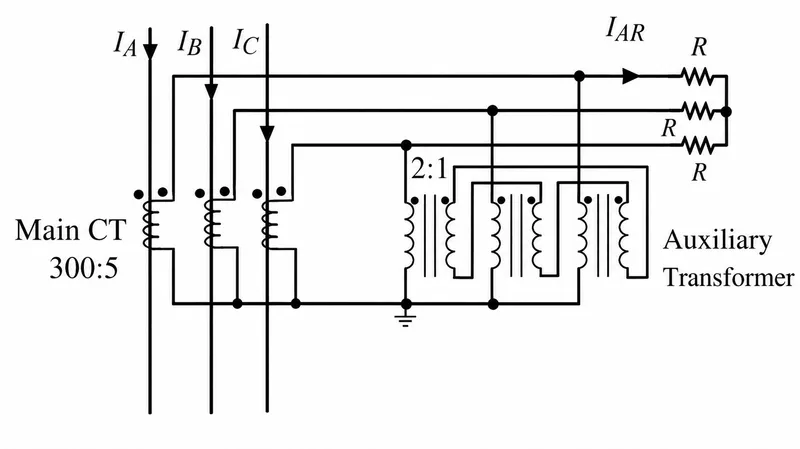
In the circuit shown, the phase currents are IA = 572.812 + j50.115 A, IB = −254.525−j459.175 A, IC = −207.083+j444.091 A. Given that the CTs are ideal with no saturation, and the turns ratio of the Main CT is 300:5 and that of the Auxil iary Transformer (Yn) is 2:1 on every phase, the value of IAR, rounded off to three decimal places, is:
Solution :
The correct answer is 0.653 17.556° A.
Analysis of the Circuit Diagram:
Based on the provided circuit diagram, we can identify the following components and connections:
1. The three-phase lines carry primary phase currents , , and flowing downwards.
2. The main current transformers are labeled Main CT 300:5 with their secondary windings star-connected and the neutral point grounded.
3. The Auxiliary Transformer has a turns ratio of 2:1 on every phase. Its primary windings are star-connected (Yn) with the neutral point grounded, and its secondary windings are delta-connected (Δ).
4. The three load resistors are labeled R, and the current flowing through the phase A relay/resistor is designated as IAR.
Step-by-Step Derivation and Calculation:
First, we write down the primary phase currents in rectangular form:
Next, we calculate the secondary currents of the Main CTs (, , ) by scaling with the Main CT turns ratio of 300:5 (which is 60:1):
The auxiliary transformer is connected in a wye-delta (Yn-d) configuration. A closed-delta secondary winding offers a path for zero-sequence currents to circulate while acting as an open circuit (high impedance) to positive and negative sequence currents.
Thus, the zero-sequence secondary current of the main CT, , flows entirely into the auxiliary transformer primary:
Substituting the values:
Converting this zero-sequence phasor to polar form to find the magnitude and phase angle:
Thus, the value of the relay current corresponding to the zero-sequence component is:
Completely free for students. Educators & coaching institutes get 2 months free Pro trial to create tests.
Access unlimited practice questions, detailed step-by-step solutions, and exam study materials — completely free for students.
Create and conduct professional online assessments with AI question generation, tab proctoring, and comprehensive batch management.

Prepare for success in the GATE Electrical Engineering exam with our comprehensive Ultimate Revision Test. Designed for aspirants aiming for top scores, this test covers all key topics in the GATE EE syllabus, including Circuit Theory, Electromagnetic Fields, Power Systems, Electrical Machines, Control Systems, and Analog & Digital Electronics. Our revision test offers a balanced mix of theory-based and application-based questions that will help you assess your understanding and boost your problem-solving skills. With carefully selected questions that mirror the difficulty level of the actual GATE exam, this test will help you identify areas for improvement and fine-tune your exam strategy.

Prepare for GATE 2026 Civil Engineering with the latest question papers, previous year papers, detailed solutions, syllabus, exam pattern, preparation tips, mock tests, and subject-wise study material. Download GATE 2026 CE question papers with solutions in PDF format and boost your preparation for top engineering institutes and PSU recruitment.
Copyright © 2026 Combe Labs Private Limited. All Rights Reserved.