
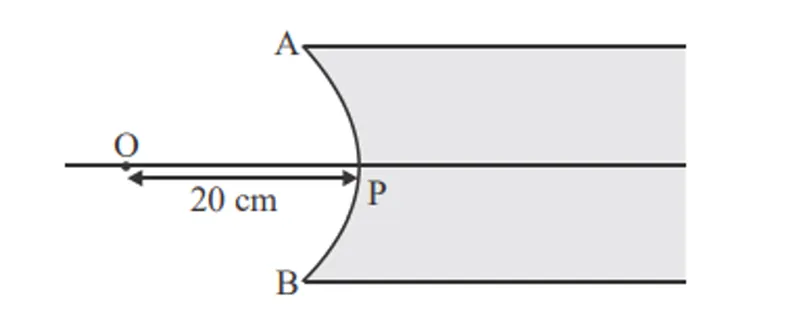
In the figure given below, APB is a curved surface of radius of curvature 10 cm separating air and transparent material (µ=4/3). A point object O is placed in a iron the principal axis of the surface 20 cm from P. The distance of the image of O from P will be ______.
Fill in the blank with the correct answer from the options given below.
Solution :
The correct option is: 16 cm left of P in air
1. Identify the given parameters from the problem statement and the provided figure:
From the given figure, we can observe that the curved boundary APB separates air (on the left) and a transparent material with refractive index (on the right).
The curved surface curves such that its center of curvature lies to the left of the vertex P (in air). Therefore, using the standard Cartesian sign convention (where the direction of incident light from left to right is taken as positive):
- Refractive index of the first medium (air),
- Refractive index of the second medium (transparent material),
- Object distance, (since the point object O is placed 20 cm to the left of P)
- Radius of curvature, (since the center of curvature is to the left of P)
2. Apply the formula for refraction at a spherical surface:
The relation between the object distance (), image distance (), radius of curvature (), and the refractive indices of the media is given by:
3. Substitute the values into the formula:
Simplify the equation step-by-step:
Rearrange to solve for :
Find a common denominator (60) for the terms on the right side:
Now, solve for :
4. Conclusion:
The negative sign indicates that the virtual image is formed to the left of the refracting surface vertex P (in the same medium as the object, which is air).
Thus, the image is formed at a distance of 16 cm left of P in air.
Completely free for students. Educators & coaching institutes get 2 months free Pro trial to create tests.
Access unlimited practice questions, detailed step-by-step solutions, and exam study materials — completely free for students.
Create and conduct professional online assessments with AI question generation, tab proctoring, and comprehensive batch management.

A comprehensive JEE Advanced 2022 Paper 1 designed to help aspirants understand the examination pattern, difficulty level, and question trends of JEE Advanced. This paper covers important concepts from Physics, Chemistry, and Mathematics, featuring a balanced mix of conceptual, numerical, and advanced application-based questions. It helps students strengthen conceptual understanding, enhance analytical and problem-solving skills, and improve speed and accuracy. Ideal for practice, revision, self-assessment, previous year trend analysis, concept reinforcement, and time management, this paper is a valuable resource for effective JEE Advanced preparation.

A comprehensive JEE Advanced 2022 Paper 2 designed to help aspirants understand the examination pattern, difficulty level, and question trends of JEE Advanced. This paper covers important concepts from Physics, Chemistry, and Mathematics, featuring a balanced mix of conceptual, numerical, and advanced application-based questions. It helps students strengthen conceptual understanding, enhance analytical and problem-solving skills, and improve speed and accuracy. Ideal for practice, revision, self-assessment, previous year trend analysis, concept reinforcement, and time management, this paper is a valuable resource for effective JEE Advanced preparation.
Copyright © 2026 Combe Labs Private Limited. All Rights Reserved.


