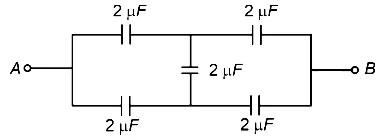
In the following circuit, the equivalent capacitance between terminal A and terminal B is :
Correct Answer :
2 μF
Solution :
To find the equivalent capacitance between terminal A and terminal B, we can analyze the given circuit diagram. The circuit consists of five capacitors, each with a capacitance of 2 μF, arranged in a bridge network.
Let us label the internal junctions of the bridge:
- Let C be the junction between the top-left 2 μF capacitor and the top-right 2 μF capacitor.
- Let D be the junction between the bottom-left 2 μF capacitor and the bottom-right 2 μF capacitor.
The arrangement forms a Wheatstone bridge where:
- The top-left arm is
- The top-right arm is
- The bottom-left arm is
- The bottom-right arm is
- The central bridge arm is
We check the balance condition of the Wheatstone bridge by calculating the ratio of the capacitances in the arms:
Since the ratio of the arms is equal:
The bridge is balanced. This means that the electric potential at node C is equal to the electric potential at node D (). As a result, no charge flows through or accumulates on the central capacitor (), and it can be removed from the circuit analysis.
Once the central capacitor is removed, the circuit simplifies into two parallel branches:
1. Upper Branch: The capacitors and are connected in series.
2. Lower Branch: The capacitors and are connected in series.
Calculating the equivalent capacitance of the upper branch ():
Calculating the equivalent capacitance of the lower branch ():
Now, the equivalent capacitance of the entire circuit between A and B () is the parallel combination of the upper and lower branches:
Therefore, the equivalent capacitance between terminal A and terminal B is 2 μF.
Access expert-curated educational resources and study materials—completely free.
Create, conduct, and manage professional online assessments with Mindyard. Perfect for teachers and institutes.
Copyright © 2026 Mindyard. All Rights Reserved.