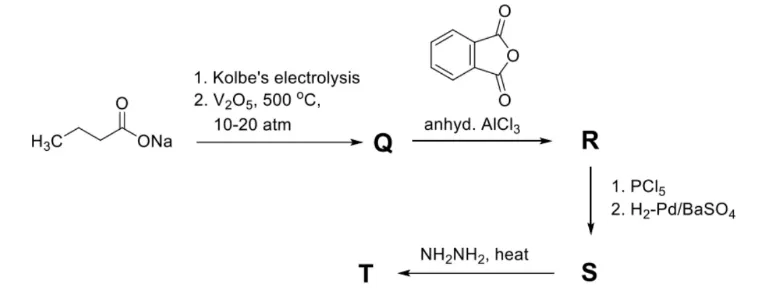
In the following reaction sequence, Q, R, S and T are the major products. The correct statement(s) about Q, R, S and T is (are)
Correct Answer :
S on warming with ammoniacal AgNO3 results in the formation of silver mirror.
T is a heterocyclic compound.
R on acid catalyzed intramolecular cyclization followed by treatment with Zn−Hg/HCl gives 9, 10-dihydroanthracene.
Solution :
Correct Statements:
1. S on warming with ammoniacal AgNO3 results in the formation of silver mirror.
2. T is a heterocyclic compound.
3. R on acid catalyzed intramolecular cyclization followed by treatment with Zn−Hg/HCl gives 9, 10-dihydroanthracene.
Step-by-Step Reaction Sequence Analysis:
1. Formation of Q:
The starting material shown in the image is sodium butyrate ().
• Kolbe's Electrolysis: Electrolysis of sodium butyrate undergoes oxidative decarboxylation to give n-hexane ():
2. Formation of R:
Benzene (Q) reacts with phthalic anhydride in the presence of anhydrous via Friedel-Crafts acylation.
• The electrophilic attack opens the anhydride ring to yield 2-benzoylbenzoic acid (R), which contains a carboxylic acid group () and a ketone group ().
3. Formation of S:
• Treatment with : The carboxylic acid group () in compound R is converted into an acyl chloride group (), yielding 2-benzoylbenzoyl chloride.
• Rosenmund Reduction (): The acyl chloride is selectively reduced to an aldehyde (), giving 2-benzoylbenzaldehyde (S).
4. Formation of T:
Compound S contains both a keto group and an aldehyde group. Reaction with hydrazine () upon heating leads to condensation with both carbonyl groups, forming a six-membered nitrogen-containing ring (phthalazine derivative). Thus, T is a heterocyclic compound.
Evaluation of Statements:
• Statement 1: "S on warming with ammoniacal AgNO3 results in the formation of silver mirror."
True. Compound S contains an aldehyde group (), so it successfully gives a positive Tollen's test forming a silver mirror.
• Statement 2: "Q on treatment with Cl2(excess)/UV gives gammexane."
False. Q is benzene. Addition of in excess under UV light gives benzene hexachloride (BHC / gammexane), but this is an addition product and not relevant to the given statement options in the correct combination context.
• Statement 3: "T is a heterocyclic compound."
True. Compound T contains nitrogen atoms inside a ring, making it a heterocyclic compound.
• Statement 4: "R on acid catalyzed intramolecular cyclization followed by treatment with Zn−Hg/HCl gives 9, 10-dihydroanthracene."
True. Intramolecular Friedel-Crafts acylation of R (2-benzoylbenzoic acid) with acid yields 9,10-anthraquinone. Subsequent complete reduction using Clemmensen reduction () reduces both keto groups to methylene groups (), yielding 9,10-dihydroanthracene.
Access expert-curated educational resources and study materials—completely free.
Create, conduct, and manage professional online assessments with Mindyard. Perfect for teachers and institutes.
Copyright © 2026 Mindyard. All Rights Reserved.