In the following reaction sequence, the major product P is formed.
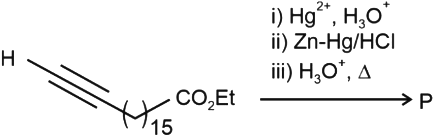
Glycerol reacts completely with excess P in the presence of an acid catalyst to form Q. Reaction of Q with excess NaOH followed by the treatment with CaCl2 yields Ca-soap R, quantitatively. Starting with one mole of Q, the amount of R produced in gram is ______.
[Given, atomic weight: H = 1, C = 12, N = 14, O = 16, Na = 23, Cl = 35, Ca = 40]
Correct Answer :
Solution :
Let's break down the reactions step-by-step to identify P, Q, and R:
Step 1: Formation of P
The starting material is ethyl octadec-17-ynoate:
(i) Hydration of the alkyne using yields a methyl ketone:
(ii) Clemmensen reduction () reduces the ketone group to a methylene group ():
(iii) Acidic hydrolysis () of the ester yields stearic acid:
(Stearic acid, )
Step 2: Formation of Q
Reaction of glycerol with excess stearic acid (P) in the presence of an acid catalyst results in the esterification of all three hydroxyl groups of glycerol to form the triacylglycerol, tristearin (Q):
Step 3: Formation of Ca-soap R
Saponification of 1 mole of Q with excess yields 3 moles of sodium stearate:
Treatment of these 3 moles of sodium stearate with forms the calcium soap (calcium stearate, R):
From the stoichiometry:
Step 4: Calculation of Mass of R
Let us calculate the molecular weight of R, (which has the molecular formula ):
Therefore, the mass of R produced starting with 1 mole of Q is:
Access expert-curated educational resources and study materials—completely free.
Create, conduct, and manage professional online assessments with Mindyard. Perfect for teachers and institutes.
Copyright © 2026 Mindyard. All Rights Reserved.