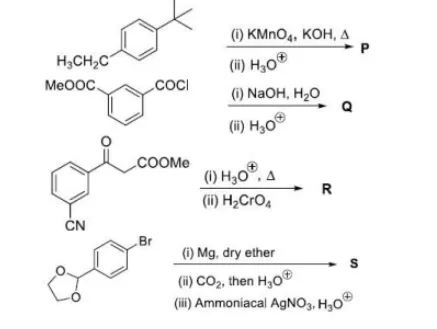
In the following reactions, P, Q, R, and S are the major products. The correct statement(s) about P, Q, R, and S is(are):
Correct Answer :
Compounds Q and R are the same.
R does not undergo aldol condensation and S does not undergo Cannizzaro reaction.
Solution :
Correct Statements:
1. Compounds Q and R are the same.
2. R does not undergo aldol condensation and S does not undergo Cannizzaro reaction.
Step-by-step Identification of Products P, Q, R, and S:
1. Formation of P:
The starting material is 1-tert-butyl-4-ethylbenzene.
Reaction with alkaline followed by acidic hydrolysis oxidizes the ethyl group containing benzylic hydrogens into a carboxylic acid substituent (). The tert-butyl group lacks benzylic hydrogens and remains resistant to oxidation.
Thus, product P is 4-tert-butylbenzoic acid (a monocarboxylic acid).
2. Formation of Q:
The starting material is methyl 3-(chlorocarbonyl)benzoate.
Treatment with aqueous hydrolyzes the reactive acyl chloride group () as well as the ester group () to carboxylate salts, which upon acidification () yield benzene-1,3-dicarboxylic acid (isophthalic acid).
Thus, product Q is isophthalic acid.
3. Formation of R:
The starting material is methyl 3-(3-cyanophenyl)-3-oxopropanoate.
(i) Hydrolysis with hydrolyzes the nitrile group () into a carboxylic acid () and the ester into a β-keto acid, which readily undergoes thermal decarboxylation to give 3-acetylbenzoic acid.
(ii) Subsequent reaction with chromic acid (, haloform-like or oxidative cleavage of acetyl group) oxidizes the acetyl group () into a carboxylic acid group.
Thus, product R is also benzene-1,3-dicarboxylic acid (isophthalic acid).
4. Formation of S:
The starting material is 2-(4-bromophenyl)-1,3-dioxolane.
(i) Reaction with in dry ether forms a Grignard reagent at the aromatic bromide position.
(ii) Reaction with followed by introduces a carboxylic acid group () and hydrolyzes the cyclic acetal protection back into a formyl group (), yielding 4-formylbenzoic acid.
(iii) Treatment with ammoniacal (Tollens' reagent) selectively oxidizes the aldehyde group () to a carboxylic acid group.
Thus, product S is benzene-1,4-dicarboxylic acid (terephthalic acid).
Evaluation of Statements:
• P and Q are monomers of polymers dacron and glyptal, respectively: Incorrect. Terephthalic acid (S) and ethylene glycol form Dacron, while phthalic acid (or isophthalic acid Q) and glycerol form Glyptal. P is 4-tert-butylbenzoic acid, which is not a monomer for Dacron.
• P, Q, and R are dicarboxylic acids: Incorrect. Q and R are dicarboxylic acids, but P is a monocarboxylic acid.
• Compounds Q and R are the same: Correct. Both Q and R are benzene-1,3-dicarboxylic acid (isophthalic acid).
• R does not undergo aldol condensation and S does not undergo Cannizzaro reaction: Correct.
- Product R (isophthalic acid) has no α-hydrogens next to a carbonyl group of an aldehyde/ketone to form an enolate, so it does not undergo aldol condensation.
- Product S (terephthalic acid) contains only carboxylic acid groups (no aldehyde functionality), so it cannot undergo the Cannizzaro reaction.
Access expert-curated educational resources and study materials—completely free.
Create, conduct, and manage professional online assessments with Mindyard. Perfect for teachers and institutes.
Copyright © 2026 Mindyard. All Rights Reserved.