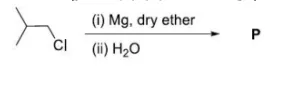
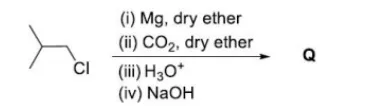
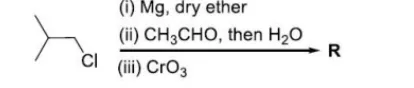
In the following reactions, P, Q, R,and S are the major products.
The correct statement about P, Q, R,and S is:
Correct Answer :
Q undergoes Kolbe’s electrolysis to give an eight-carbon product.
Solution :
Correct Statement: Q undergoes Kolbe’s electrolysis to give an eight-carbon product.
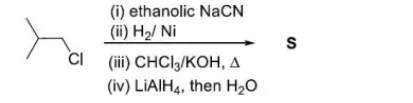
Let us analyze each reaction step-by-step using the starting material, 1-chloro-2-methylpropane (isobutyl chloride, (CH3)2CHCH2Cl), as shown in the images provided:
1. Formation of Product P:
Reaction steps:
(i) Isobutyl chloride reacts with Mg in dry ether to form the Grignard reagent, isobutylmagnesium chloride:
(CH3)2CHCH2Cl + Mg → (CH3)2CHCH2MgCl
(ii) Protonation with H2O gives isobutane (2-methylpropane):
(CH3)2CHCH2MgCl + H2O → (CH3)2CHCH3 + Mg(OH)Cl
Thus, P is an alkane (isobutane), not an alcohol. Statement 1 is incorrect.
2. Formation of Product Q:
Reaction steps:
(i) Isobutyl chloride with Mg in dry ether forms (CH3)2CHCH2MgCl.
(ii) Reaction with CO2 followed by (iii) acid hydrolysis (H3O+) yields 3-methylbutanoic acid:
(CH3)2CHCH2COOH (a 5-carbon carboxylic acid).
(iv) Treatment with NaOH yields sodium 3-methylbutanoate:
Q = (CH3)2CHCH2COONa
Kolbe's electrolysis of a sodium salt of carboxylate R-COONa proceeds via free radical dimerization at the anode to form R-R:
The resulting hydrocarbon product is 2,5-dimethylhexane, which contains exactly 8 carbon atoms (4 carbons from each alkyl fragment). Thus, Statement 2 is correct.
3. Formation of Product R:
Reaction steps:
(i) & (ii) Grignard reagent (CH3)2CHCH2MgCl reacts with acetaldehyde (CH3CHO) followed by hydrolysis to yield 4-methylpentan-2-ol (a secondary alcohol with 6 carbons).
(iii) Oxidation with CrO3 converts the secondary alcohol to a ketone, 4-methylpentan-2-one:
R = (CH3)2CHCH2COCH3
Since R is a ketone (and possesses α-hydrogens), it does not undergo the Cannizzaro reaction. Statement 3 is incorrect.
4. Formation of Product S:
Reaction steps:
(i) Nucleophilic substitution with ethanolic NaCN gives 3-methylbutanenitrile: (CH3)2CHCH2CN.
(ii) Reduction with H2/Ni converts the nitrile to a 1° amine, 3-methylbutan-1-amine: (CH3)2CHCH2CH2NH2 (5 carbons).
(iii) Carbylamine reaction (CHCl3/KOH, Δ) converts the 1° amine into an isocyanide: (CH3)2CHCH2CH2NC.
(iv) Reduction of the isocyanide with LiAlH4 yields a secondary amine, N-methyl-3-methylbutan-1-amine:
S = (CH3)2CHCH2CH2NHCH3 (6 carbons)
Thus, S is a secondary amine, not a primary amine. Statement 4 is incorrect.
Conclusion:
The only correct statement is that Q undergoes Kolbe’s electrolysis to give an eight-carbon product.
Access expert-curated educational resources and study materials—completely free.
Create, conduct, and manage professional online assessments with Mindyard. Perfect for teachers and institutes.
Copyright © 2026 Mindyard. All Rights Reserved.