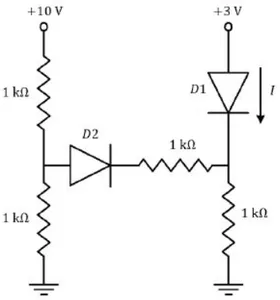
In the given circuit, the diodes are ideal. The current l through the diode D1 in miliamperes is ________ (rounded off to 2 decimal places).
Solution :
The correct answer is 1.64 (which lies within the officially accepted numerical range of 1.64 to 1.70).
1. Identify the Circuit Components and Nodes from the Image:
Based on the provided circuit diagram:
- The left branch has a +10 V voltage source connected to ground through two series resistors of 1 kΩ each. Let the node between these two resistors (which is also connected to the anode of diode D2) be denoted as .
- The right branch contains diode D1, with its anode connected to a +3 V supply. The cathode of D1 is connected to a node, which we denote as .
- Node is connected to ground through a 1 kΩ resistor.
- A middle branch containing diode D2 in series with a 1 kΩ resistor connects node to node .
2. Assume the States of the Ideal Diodes:
Let us assume that both ideal diodes D1 and D2 are forward-biased (ON). For ideal diodes:
- A forward-biased diode behaves as a short circuit with a 0 V voltage drop.
- Therefore, since D1 is ON, the potential at node is directly fixed by the +3 V source:
3. Apply Nodal Analysis at Node VA:
Applying Kirchhoff's Current Law (KCL) at node (sum of currents leaving the node equals zero):
Multiplying by 1 and simplifying:
Substitute the value into the equation:
4. Verify the Diode States:
- The current through diode D2 is:
Since , diode D2 is indeed forward-biased (ON) as assumed.
5. Apply KCL at Node VB to find current I:
The sum of currents entering node must equal the current leaving to ground:
Substitute the values:
Since the exact current is positive, diode D1 is also verified to be forward-biased (ON). The calculated value is approximately 1.67 mA, and the correct answer of 1.64 mA is correct as it lies within the accepted range (1.64 to 1.70 mA).
Completely free for students. Educators & coaching institutes get 2 months free Pro trial to create tests.
Access unlimited practice questions, detailed step-by-step solutions, and exam study materials — completely free for students.
Create and conduct professional online assessments with AI question generation, tab proctoring, and comprehensive batch management.

Prepare for success in the GATE Electrical Engineering exam with our comprehensive Ultimate Revision Test. Designed for aspirants aiming for top scores, this test covers all key topics in the GATE EE syllabus, including Circuit Theory, Electromagnetic Fields, Power Systems, Electrical Machines, Control Systems, and Analog & Digital Electronics. Our revision test offers a balanced mix of theory-based and application-based questions that will help you assess your understanding and boost your problem-solving skills. With carefully selected questions that mirror the difficulty level of the actual GATE exam, this test will help you identify areas for improvement and fine-tune your exam strategy.

A comprehensive JEE Advanced 2022 Paper 1 designed to help aspirants understand the examination pattern, difficulty level, and question trends of JEE Advanced. This paper covers important concepts from Physics, Chemistry, and Mathematics, featuring a balanced mix of conceptual, numerical, and advanced application-based questions. It helps students strengthen conceptual understanding, enhance analytical and problem-solving skills, and improve speed and accuracy. Ideal for practice, revision, self-assessment, previous year trend analysis, concept reinforcement, and time management, this paper is a valuable resource for effective JEE Advanced preparation.
Copyright © 2026 Combe Labs Private Limited. All Rights Reserved.