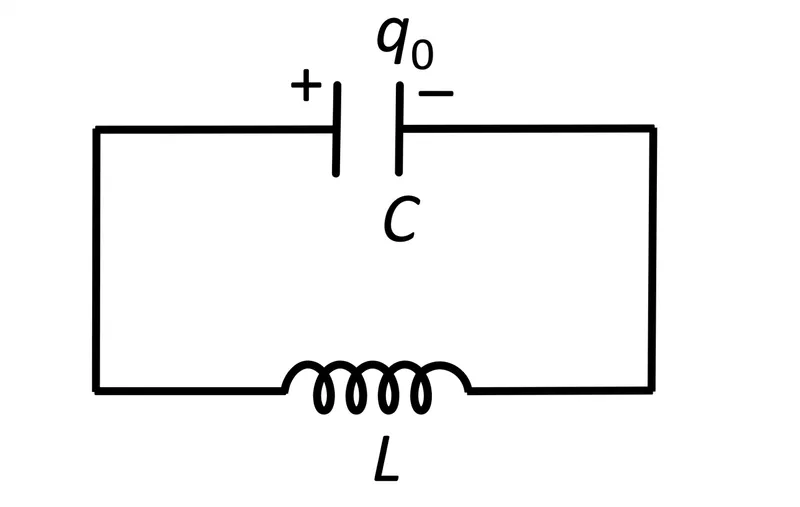
In the given L-C circuit, charge on the capacitor is maximum at 𝑡 = 0, find time at which charge becomes 25% of it's initial value first time.
Correct Answer :
Solution :
Correct Option:
Step-by-Step Explanation:
In an ideal LC circuit consisting of an inductor of inductance L and a capacitor of capacitance C, charge on the capacitor oscillates simple harmonically with time according to the equation:
where:
• is the maximum initial charge at .
• is the angular frequency of LC oscillations, given by .
We are required to find the time t when the charge becomes 25% of its initial maximum value for the first time.
25% of the initial charge can be written as:
Substituting into the charge oscillation equation:
Dividing both sides by :
Taking the inverse cosine on both sides:
Rearranging for time t:
Since , we have = . Substituting this back gives:
Thus, the time at which the charge on the capacitor becomes 25% of its initial value for the first time is .
Access expert-curated educational resources and study materials—completely free.
Create, conduct, and manage professional online assessments with Mindyard. Perfect for teachers and institutes.
Copyright © 2026 Mindyard. All Rights Reserved.