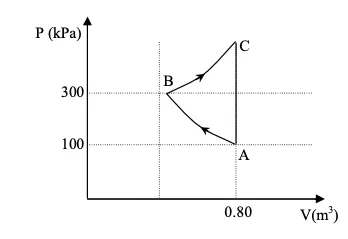
In the given P-V diagram, a monoatomic gas () is first compressed adiabatically from state A to state B. Then it expands isothermally from state B to state C. [Given: , ].
Which of the following statements (s) is (are) correct ?
Correct Answer :
The magnitude of the work done in the process B → C is 84 kJ.
The magnitude of the work done in the process A → B is 60 kJ.
The magnitude of the work done in the process C → A is zero.
Solution :
The correct statements are:
• The magnitude of the work done in the process B → C is 84 kJ.
• The magnitude of the work done in the process A → B is 60 kJ.
• The magnitude of the work done in the process C → A is zero.
Step-by-step Explanation:
1. Extracting data from the P-V diagram:
From the given P-V diagram:
At state A:
Pressure,
Volume,
At state B:
Pressure,
Monoatomic gas adiabatic exponent:
2. Analysis of process A → B (Adiabatic Compression):
Since process A → B is adiabatic:
Taking ratio:
Using the given approximation :
The work done during an adiabatic process is given by:
Substituting the values:
Therefore, the magnitude of the work done in process A → B is 60 kJ.
3. Analysis of process B → C (Isothermal Expansion):
Process B → C is an isothermal expansion where the volume expands from to .
The work done during an isothermal expansion is given by:
Substituting the values:
Using the given approximation :
Therefore, the magnitude of the work done in process B → C is 84 kJ.
4. Analysis of process C → A (Isochoric Process):
Process C → A takes place at a constant volume ().
Work done in an isochoric process is zero:
Therefore, the magnitude of the work done in process C → A is zero.
Total Work Done:
Hence, the total work done is 24 kJ, making the first option incorrect.
Access expert-curated educational resources and study materials—completely free.
Create, conduct, and manage professional online assessments with Mindyard. Perfect for teachers and institutes.
Copyright © 2026 Mindyard. All Rights Reserved.