Insulin in the human body is secreted by pancreas as prohormone/proinsulin.The schematic polypetide structure of proinsulin is given below. This proinsulin needs to undergo processing before it becomes functional in the body. Answer the questions that follow.
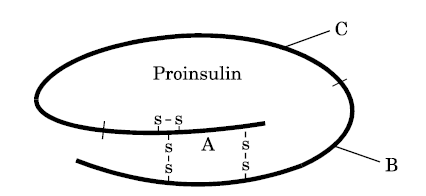
(a) State the change the proinsulin undegoes at the time of its processing to become functional.
(b) Name the technique the American company Eli Lilly used for the commercial production of human insulin.
(c) How are the two polypeptides of a functional insulin chemically held together ?
Correct Answer :
(a) ‘C’ Peptide is removed
(b) r-DNA technology / Recombinant DNA Technology
(c) Disulphide bonds
Solution :
Correct Answer:
(a) ‘C’ Peptide is removed
(b) r-DNA technology / Recombinant DNA Technology
(c) Disulphide bonds
Step-by-Step Explanation:
(a) Processing of Proinsulin to Functional Insulin:
In the human body, insulin is initially synthesized as an inactive zymogen or prohormone called proinsulin, as labeled in the provided schematic diagram.
The diagram shows that proinsulin contains three distinct peptide chains:
(b) Commercial Production of Human Insulin by Eli Lilly:
In 1983, the American pharmaceutical company Eli Lilly successfully produced human insulin (named Humulin) commercially using Recombinant DNA (r-DNA) Technology.
They achieved this by chemically synthesizing two separate DNA sequences that code for the A and B chains of human insulin. These sequences were then inserted into plasmids of the bacterium Escherichia coli to express the A and B chains separately. The separately produced chains were extracted, purified, and subsequently bonded together chemically to form active human insulin.
(c) Chemical Bonding in Functional Insulin:
As represented in the schematic diagram by the vertical dashed lines labeled with S-S (sulfur-sulfur atoms), the A and B polypeptide chains are chemically linked together.
Specifically, they are held together by covalent disulphide bonds (disulfide bridges) formed between the thiol groups of cysteine residues present in both polypeptide chains. These bonds ensure the stability and proper three-dimensional conformation of the functional insulin hormone.
Access expert-curated educational resources and study materials—completely free.
Create, conduct, and manage professional online assessments with Mindyard. Perfect for teachers and institutes.
Copyright © 2026 Mindyard. All Rights Reserved.
 Set - 3-1782888548748.webp)