
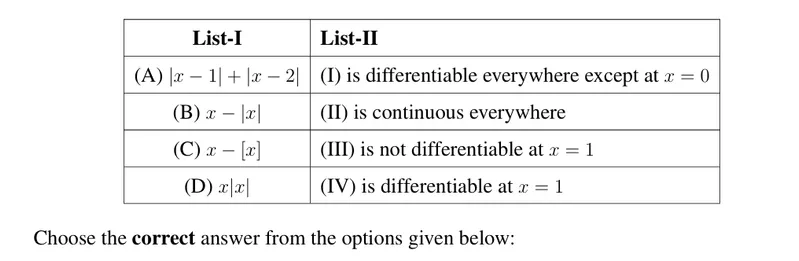
Let [x] denote the greatest integer function. Then match List-I with List-II:
Correct Answer :
(A)- (II), (B)- (I), (C)- (III), (D)- (IV)
Solution :
The correct option is: (A)- (II), (B)- (I), (C)- (III), (D)- (IV)
Let us analyze each function in List-I one by one and match it with the correct property in List-II based on the visual details and formulas provided in the lists:
(A) Analysis of :
The absolute value function is continuous everywhere on the real number line.
Since the sum of two continuous functions is also continuous, the function is continuous everywhere.
Thus, (A) matches with (II).
(B) Analysis of :
We can rewrite this piecewise function as:
For :
For :
Now let us check the differentiability at :
Right-hand derivative (RHD) at :
Left-hand derivative (LHD) at :
Since at , the function is not differentiable at . For all other real values of , the function is linear and therefore differentiable.
Thus, is differentiable everywhere except at , which means (B) matches with (I).
(C) Analysis of :
Here represents the greatest integer function. The function is the fractional part function, denoted by .
This function has a discontinuity at every integer. Let us verify its continuity at :
Since the left-hand limit and right-hand limit at are not equal, is discontinuous at .
Any function that is discontinuous at a point is also non-differentiable at that point. Thus, is not differentiable at .
Thus, (C) matches with (III).
(D) Analysis of :
We can rewrite this function as:
For :
For :
In a neighborhood around (where ), the function is represented by .
Since is a polynomial function, it is differentiable everywhere on its domain, and specifically at where its derivative is .
Thus, is differentiable at , which means (D) matches with (IV).
Conclusion:
Combining the matches:
• (A) matches with (II)
• (B) matches with (I)
• (C) matches with (III)
• (D) matches with (IV)
Access expert-curated educational resources and study materials—completely free.
Create, conduct, and manage professional online assessments with Mindyard. Perfect for teachers and institutes.
Copyright © 2026 Mindyard. All Rights Reserved.




