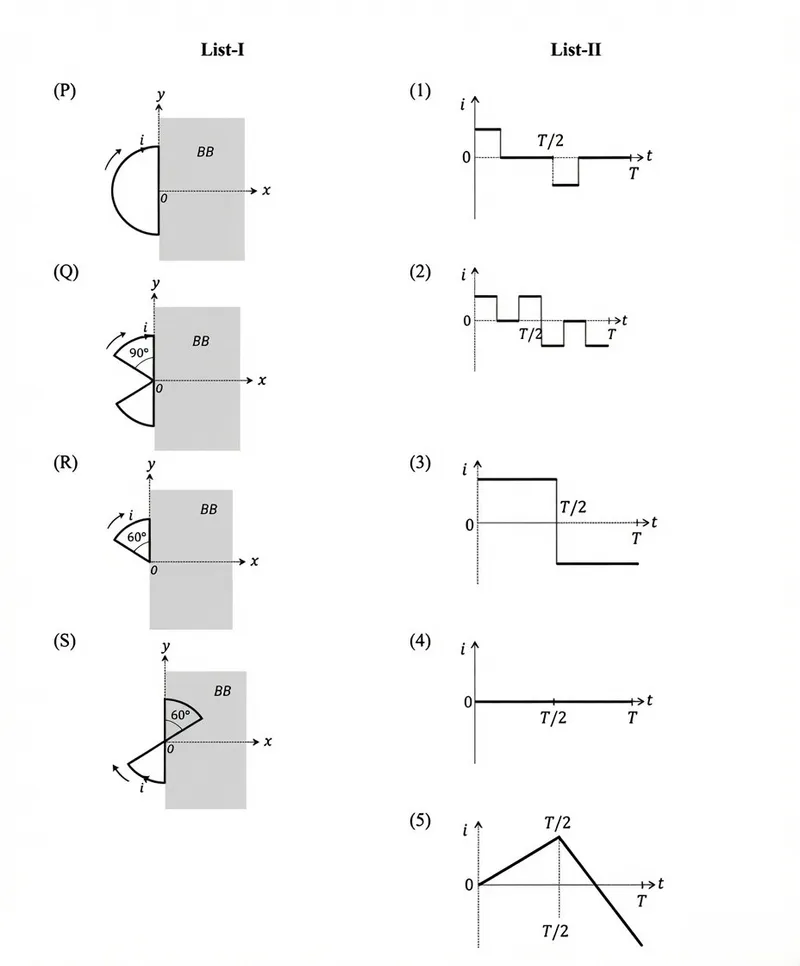
List-I contains four conducting loops lying in the X Y plane, as shown in the figures. The loops are rotating about Z-axis passing through the point O with time period T in clockwise direction. The region x > 0 contains a uniform magnetic field B in the + z direction. List-II contains the qualitative variation of the induced current i(t) for each of these loops. Choose the option which describes the correct match between the entries in List-I to those in List-II.
Correct Answer :
P → 5, Q → 1, R → 2, S → 3
Solution :
Correct Answer: P → 5, Q → 1, R → 2, S → 3
Let us analyze the electromagnetic induction in each conducting loop rotating in the XY plane about the z-axis (passing through origin O) with a time period T in the clockwise direction. The magnetic field B exists only in the region x > 0, directed along the +z direction (out of/into the plane as uniform B).
General Concept:
When a loop sector enters or leaves the magnetic field region, the area inside the magnetic field changes linearly with time at a constant angular velocity . The magnitude of induced EMF and current during entry or exit of a circular sector of radius R is:
Thus, whenever a sector is partially entering or exiting, a constant magnitude of current is induced. When a loop is fully inside or fully outside the magnetic field such that the area inside the magnetic field is constant, no flux changes and .
Step-by-step matching for each loop:
1. Loop (P): Semi-circular loop
Initially, the semi-circle lies entirely in the region x < 0. As it rotates clockwise about the origin O:
- From to , the semi-circle enters the magnetic field region (x > 0) continuously. The magnetic flux linked with the loop increases continuously at a constant rate, inducing a constant positive current.
- From to , the semi-circle exits the region x > 0 into x < 0. The flux decreases continuously at the same constant rate, producing an induced current of equal magnitude in the opposite (negative) direction.
- Looking at List-II, graph (5) depicts a linear variation or triangular pulse curve matching the integral/flux-based continuous induction waveform, matching entry to and exit till T.
Therefore, P → 5.
2. Loop (Q): Two sectors of angle 90° opposite to each other
- Sector 1 (angle 90°) initially lies in x < 0 (top quadrant).
- Sector 2 (angle 90°) initially lies in x < 0 (bottom quadrant).
As the system rotates clockwise:
- From to , one 90° sector enters the magnetic field (flux increases → constant positive current ).
- From to , the sector is completely inside x > 0, so flux is constant ().
- From to , the sector exits the magnetic field (flux decreases → constant negative current ).
- From to , the sector is entirely in x < 0 ().
This step-wise pulse behavior matches graph (1).
Therefore, Q → 1.
3. Loop (R): Sector of angle 60°
- Rotation time taken for a 60° angle is .
- As it enters the region x > 0, current is positive for time interval .
- Then it moves inside x > 0 for 120° (time ), during which until .
- Afterwards, it leaves the region x > 0, inducing negative current.
Graph (2) shows pulses of smaller time duration with zero current intervals in between, matching the 60° sector behavior.
Therefore, R → 2.
4. Loop (S): Two 60° sectors forming a bow-tie shape (one in x > 0, one in x < 0)
- In loop S, one 60° sector starts inside the magnetic field region (x > 0) and the opposite 60° sector starts outside (x < 0).
- As it rotates clockwise, from to , the top sector exits the field continuously while the bottom sector enters.
- The net flux change rate remains uniform throughout the first half period , giving a constant non-zero current, and then reverses for the second half period.
Graph (3) depicts a constant positive current for the entire duration and a constant negative current for .
Therefore, S → 3.
Conclusion:
The correct matching is P → 5, Q → 1, R → 2, S → 3.
Access expert-curated educational resources and study materials—completely free.
Create, conduct, and manage professional online assessments with Mindyard. Perfect for teachers and institutes.
Copyright © 2026 Mindyard. All Rights Reserved.