List-I contains various reaction sequences and List-II contains the possible products. Match each entry in List-I with the appropriate entry in List-II and choose the correct option.
| List-I | List-II | ||
| (P) | 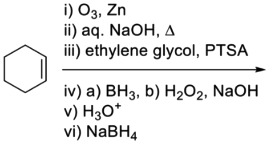 |
(1) |  |
| (Q) | 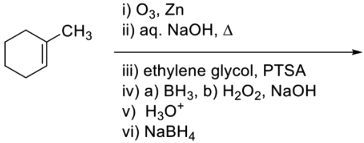 |
(2) |  |
| (R) | 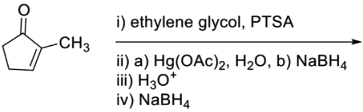 |
(3) | |
| (S) | 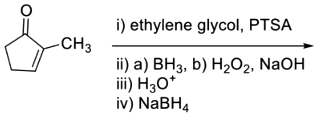 |
(4) |  |
| (5) | 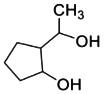 |
Correct Answer :
P-3, Q-5, R-4, S-1
Solution :
The correct option is P-3, Q-5, R-4, S-1.
Let us analyze the reaction sequence for each entry in List-I step-by-step:
Reaction (P): Starting with cyclohexene (shown in image_0):
1. Ozonolysis (, ): Cleavage of the double bond of cyclohexene yields hexanedial:
.
2. Intramolecular Aldol Condensation (aq. , ): Deprotonation at C5 of hexanedial generates an enolate that attacks the aldehyde carbonyl at C1. Dehydration yields cyclopent-1-ene-1-carbaldehyde (a 5-membered ring with a group at the double-bonded carbon).
3. Protection (ethylene glycol, PTSA): The aldehyde group is protected as a cyclic acetal (1,3-dioxolane derivative), leaving the cyclopentene double bond intact.
4. Hydroboration-Oxidation (, , ): Adds water ( and ) across the double bond anti-Markovnikov. Since the acetal group is bulky, hydroboration occurs regioselectively to place the hydroxyl group () at the less-hindered C2 carbon (adjacent to the carbon bearing the protected aldehyde).
5. Deprotection (): Hydrolyzes the acetal back to the aldehyde, giving 2-hydroxycyclopentane-1-carbaldehyde.
6. Reduction (): Reduces the aldehyde () to a primary alcohol ().
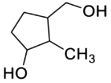
The final product is 2-(hydroxymethyl)cyclopentan-1-ol, which corresponds to entry (3) in List-II.
Reaction (Q): Starting with 1-methylcyclohexene (shown in image_2):
1. Ozonolysis (, ): Yields 6-oxoheptanal:
.
2. Intramolecular Aldol Condensation (aq. , ): Because the aldehyde carbonyl is much more reactive toward nucleophilic attack than the ketone carbonyl, deprotonation occurs preferentially at the C5 position (next to the ketone). The enolate at C5 attacks the aldehyde at C1, forming a 5-membered ring. Subsequent dehydration yields 1-(cyclopent-1-en-1-yl)ethan-1-one (1-acetylcyclopentene).
3. Protection (ethylene glycol, PTSA): Protects the ketone carbonyl of the acetyl group as a cyclic ketal.
4. Hydroboration-Oxidation (, , ): The double bond undergoes anti-Markovnikov addition of water. Boron adds to the less hindered carbon (C2), yielding the hydroxyl group at C2.
5. Deprotection (): Regenerates the ketone, forming 2-acetylcyclopentan-1-ol.
6. Reduction (): Reduces the ketone to a secondary alcohol group.
The final product is 2-(1-hydroxyethyl)cyclopentan-1-ol (shown in image_7), which corresponds to entry (5) in List-II.
Reaction (R): Starting with 2-methylcyclopent-2-en-1-one (shown in image_4):
1. Protection (ethylene glycol, PTSA): Protects the ketone group at C1 as a cyclic ketal.
2. Oxymercuration-Demercuration (, followed by ): Adds water across the double bond (between C2 and C3) with Markovnikov regioselectivity. The hydroxyl group adds to the more substituted carbon, C2 (which is bonded to the methyl group).
3. Deprotection (): Hydrolyzes the ketal back to the ketone, yielding 2-hydroxy-2-methylcyclopentan-1-one.
4. Reduction (): Reduces the C1 ketone to a secondary alcohol.
The final product is 1-methylcyclopentane-1,2-diol (shown in image_6), which corresponds to entry (4) in List-II.
Reaction (S): Starting with 2-methylcyclopent-2-en-1-one (shown in image_5):
1. Protection (ethylene glycol, PTSA): Protects the ketone group at C1 as a cyclic ketal.
2. Hydroboration-Oxidation (, , ): Adds water across the double bond (between C2 and C3) with anti-Markovnikov regioselectivity. The hydroxyl group adds to the less substituted carbon, C3.
3. Deprotection (): Hydrolyzes the ketal back to the ketone, yielding 3-hydroxy-2-methylcyclopentan-1-one.
4. Reduction (): Reduces the C1 ketone to a secondary alcohol.
The final product is 2-methylcyclopentane-1,3-diol (shown in image_1), which corresponds to entry (1) in List-II.
Access expert-curated educational resources and study materials—completely free.
Create, conduct, and manage professional online assessments with Mindyard. Perfect for teachers and institutes.
Copyright © 2026 Mindyard. All Rights Reserved.