
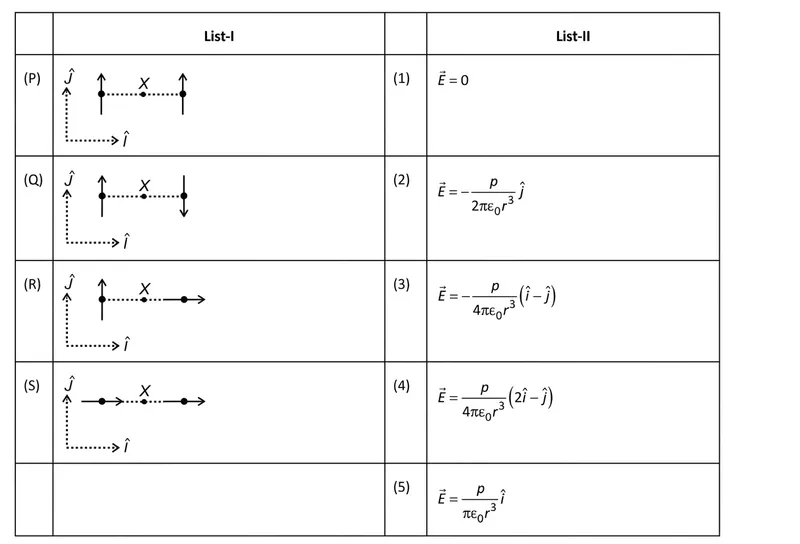
List-I shows four configurations, each consisting of a pair of ideal electric dipoles. Each dipole has a dipole moment of magnitude p, oriented as marked by arrows in the figures. In all the configurations the dipoles are fixed such that they are at a distance 2r apart along the x direction. The midpoint of the line joining the two dipoles is X. The possible resultant electric fields E at X are given in List-II.
Choose the option that describes the correct match between the entries in List-I to those in List-II.
Solution :
To find the matching between List-I and List-II, we calculate the resultant electric field at the midpoint (origin, ) due to the two electric dipoles. The left dipole is located at and the right dipole is located at . The distance of both dipoles from the midpoint is .
For a dipole with dipole moment vector :
1. At an axial point at a distance , the electric field is in the direction of the dipole moment:
2. At an equatorial point at a distance , the electric field is opposite to the direction of the dipole moment:
Let us evaluate each configuration:
Configuration (P):
Both dipoles are directed along the direction ( and ). The midpoint lies on the equatorial axis of both dipoles.
The net electric field is:
This matches with entry (2) in List-II.
Configuration (Q):
The left dipole is directed along () and the right dipole is directed along (). The midpoint lies on the equatorial axis of both dipoles.
The net electric field is:
This matches with entry (1) in List-II.
Configuration (R):
The left dipole is directed along (), so is on its equatorial axis. The right dipole is directed along (), so is on its axial line.
The net electric field is:
This matches with entry (4) in List-II.
Configuration (S):
Both dipoles are directed along the direction ( and ). The midpoint lies on the axial line of both dipoles.
The net electric field is:
This matches with entry (5) in List-II.
Therefore, the correct matching is: P→2, Q→1, R→4, S→5.
Completely free for students. Educators & coaching institutes get 2 months free Pro trial to create tests.
Access unlimited practice questions, detailed step-by-step solutions, and exam study materials — completely free for students.
Create and conduct professional online assessments with AI question generation, tab proctoring, and comprehensive batch management.

A comprehensive JEE Advanced 2022 Paper 1 designed to help aspirants understand the examination pattern, difficulty level, and question trends of JEE Advanced. This paper covers important concepts from Physics, Chemistry, and Mathematics, featuring a balanced mix of conceptual, numerical, and advanced application-based questions. It helps students strengthen conceptual understanding, enhance analytical and problem-solving skills, and improve speed and accuracy. Ideal for practice, revision, self-assessment, previous year trend analysis, concept reinforcement, and time management, this paper is a valuable resource for effective JEE Advanced preparation.

A comprehensive JEE Advanced 2022 Paper 2 designed to help aspirants understand the examination pattern, difficulty level, and question trends of JEE Advanced. This paper covers important concepts from Physics, Chemistry, and Mathematics, featuring a balanced mix of conceptual, numerical, and advanced application-based questions. It helps students strengthen conceptual understanding, enhance analytical and problem-solving skills, and improve speed and accuracy. Ideal for practice, revision, self-assessment, previous year trend analysis, concept reinforcement, and time management, this paper is a valuable resource for effective JEE Advanced preparation.
Copyright © 2026 Combe Labs Private Limited. All Rights Reserved.


