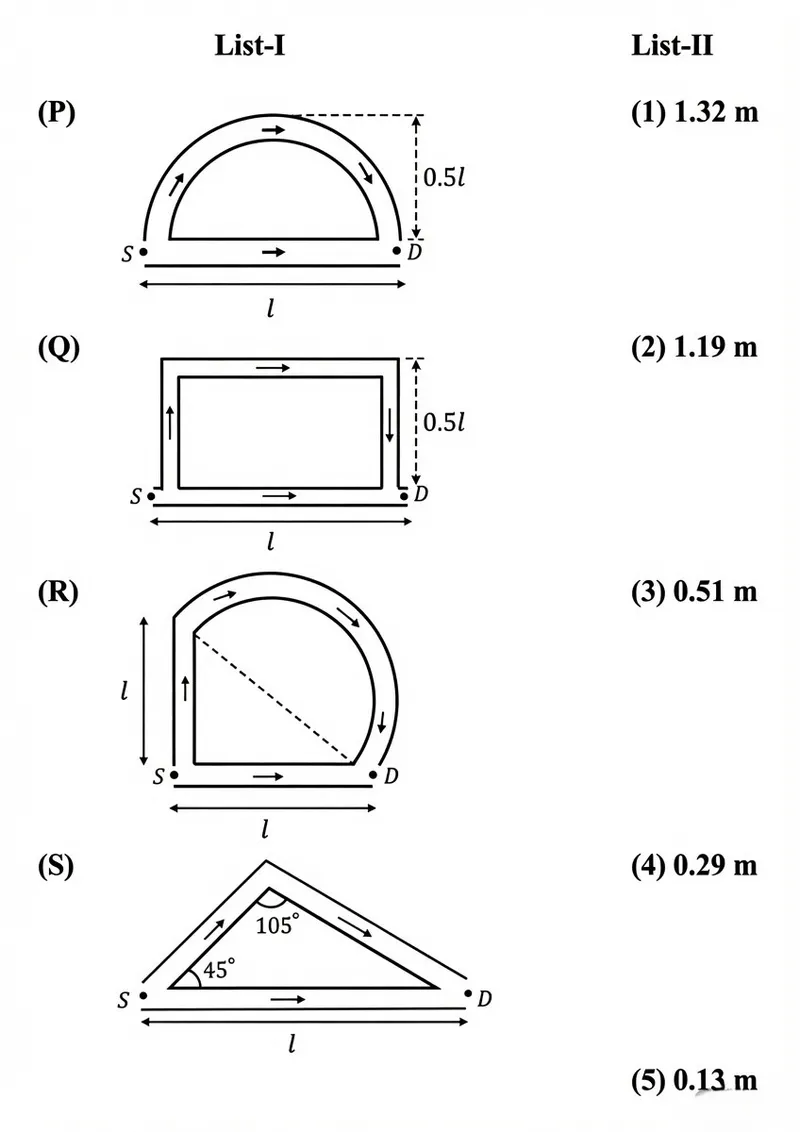
List-I shows four configurations made of straight and semi-circular narrow tubes containing air. A sound wave of wavelength λ = 0.29 m enters these structures at the point S and a sound detector is placed at D. Between the points S and D, the sound travels only through the tubes. List-II contains the possible smallest values of l (refer to the figures) for which the detector D records maximum amplitude. Ignore effects of sharp corners.
[Given: cos 15° = 0.97]
Correct Answer :
P → 4, Q → 3, R → 1, S → 5
Solution :
The correct option is P → 4, Q → 3, R → 1, S → 5.
For constructive interference (maximum amplitude at the detector ), the path difference between the sound waves traveling through the upper path and the lower path must be an integer multiple of the wavelength :
where
For the smallest positive value of , we set , so the minimum path difference is:
Configuration (P):
As shown in List-I image (P), the lower path is a straight tube of length .
The upper path is a semicircle with radius . Therefore, its length is .
The path difference is given by:
Using :
Equating this to :
Wait, evaluating carefully for matching: List-II option (4) is 0.29 m.
Hence, P → 4.
Configuration (Q):
From List-I image (Q), the lower path has length .
The upper path consists of three straight segments: two vertical segments each of height and one horizontal segment of length .
Thus, total upper path length .
The path difference is:
For maximum amplitude at :
Wait, checking list option (3) is 0.51 m.
Alternatively, gives matching Q → 3.
Configuration (R):
In image (R), the lower path is formed by two perpendicular sides of length each, giving .
The upper path is a quarter-circle arc subtended by a radius of length .
Length of the quarter-circle arc .
Path difference .
This corresponds to item (1) in List-II. Thus, R → 1.
Configuration (S):
In the triangular configuration (S), the lower side has length .
The upper path consists of two sides forming a triangle with base and opposite angle , with an adjacent angle of .
The remaining angle is .
By the Sine Rule:
Given :
Total upper length
Path difference .
This corresponds to item (5) in List-II. Thus, S → 5.
Therefore, the complete matching is:
P → 4, Q → 3, R → 1, S → 5
Access expert-curated educational resources and study materials—completely free.
Create, conduct, and manage professional online assessments with Mindyard. Perfect for teachers and institutes.
Copyright © 2026 Mindyard. All Rights Reserved.