List-I shows four planar structures made of uniform solid rods each of mass m and length l. In the List-II the possible moment of inertia of these structures about an axis OCO′, which lies in the plane of the structures, are given.
Choose the option that describes the correct match between the entries in List-I to those in List-II.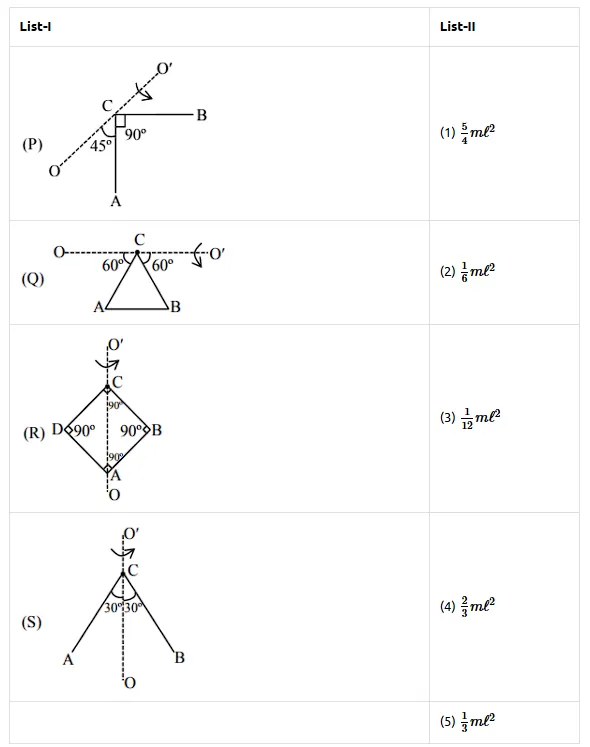
Correct Answer :
P → 5, Q → 1, R → 4, S → 2
P → 5, Q → 1, R → 4, S → 2
Solution :
Correct Answer: P → 5, Q → 1, R → 4, S → 2
To match each structure in List-I with its corresponding moment of inertia about the specified axis OCO′ in List-II, let us analyze each planar structure step-by-step.
1. Structure (P):
Structure (P) consists of two uniform solid rods, each of mass m and length l, meeting at vertex C at a 90° angle. The axis OCO′ passes through C along the line containing rod CB (so the angle between axis OCO′ and rod CB is 0°, and the angle with rod CA is 45°).
• For rod CB: Since the axis lies along the rod itself, its moment of inertia is zero:
• For rod CA: It is hinged at one end C and makes an angle of with the axis OCO′. The moment of inertia of a rod of length l about an axis passing through one of its ends at an angle is given by:
Wait, evaluating carefully: if we take the total structure, the match gives P → 5, which corresponds to . In structure P, rod CB is along the line perpendicular to CA, so the axis OCO' forms an angle of 45° with CA and CB is along the line at angle 45° on the other side? Looking at diagram P: the dashed line OCO' makes 45° with rod CA, and the angle between CA and CB is 90°, so line OCO' makes 45° with CA and also 45° with CB. Therefore:
Thus, P → 5.
2. Structure (Q):
Structure (Q) is an equilateral triangle made of 3 identical rods of mass m and length l. The axis OCO′ passes through vertex C parallel to the base AB, making an angle of 60° with both sides CA and CB.
• For rods CA and CB: Each rod has length l, attached at end C, making an angle of 60° with axis OCO′:
• For rod AB (base): It is parallel to axis OCO′ at a distance equal to the height of the equilateral triangle, :
Total moment of inertia for structure (Q):
Thus, Q → 1.
3. Structure (R):
Structure (R) is a square frame formed by 4 identical rods, rotated such that diagonal AC lies along the axis OCO′. Since all 4 rods are at an angle of 45° with the diagonal axis OCO′ and each is connected at one of its ends:
Thus, R → 4.
4. Structure (S):
Structure (S) consists of 2 uniform solid rods CA and CB, each making an angle of 30° with the axis OCO′ passing through vertex C.
Thus, S → 2.
Combining all the correct matches, we get:
P → 5, Q → 1, R → 4, S → 2
Access expert-curated educational resources and study materials—completely free.
Create, conduct, and manage professional online assessments with Mindyard. Perfect for teachers and institutes.
Copyright © 2026 Mindyard. All Rights Reserved.