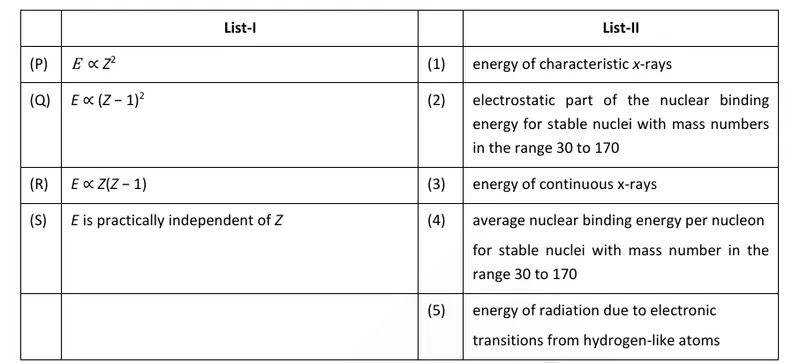
List-I shows various functional dependencies of energy (E) on the atomic number (Z). Energies associated with certain phenomena are given in List-II.
Choose the option that describes the correct match between the entries in List-I to those in List-II.
Correct Answer :
P→5, Q→1, R→2, S→4
Solution :
To find the correct match between List-I and List-II, let us analyze each of the physical processes and their dependencies on the atomic number :
1. Entry (P):
According to Bohr's model of hydrogen-like atoms, the energy of an electron in the -th orbit is given by:
Therefore, the energy of radiation emitted during an electronic transition between two states is proportional to .
2. Entry (Q):
According to Moseley's law for characteristic X-rays (specifically X-rays), the frequency of the emitted characteristic X-ray is given by:
where is the screening constant (with for the K-series). Since the photon energy is , we have:
This matches entry (1) in List-II: energy of characteristic x-rays.
3. Entry (R):
The electrostatic (Coulomb) potential energy of a nucleus is due to the mutual electrostatic repulsion between protons. If there are protons in the nucleus, the number of proton pairs experiencing electrostatic repulsion is:
Since the electrostatic energy is proportional to the number of interacting proton pairs, the electrostatic part of the nuclear binding energy is proportional to .
4. Entry (S): is practically independent of
For stable nuclei in the mass number range , the average binding energy per nucleon is nearly constant (approximately ). Because the curve of binding energy per nucleon is highly flat in this region, the average nuclear binding energy per nucleon is practically independent of the atomic number .
This matches entry (4) in List-II: average nuclear binding energy per nucleon for stable nuclei with mass number in the range 30 to 170.
Hence, S → 4.
Combining all the matches:
P → 5, Q → 1, R → 2, S → 4
Access expert-curated educational resources and study materials—completely free.
Create, conduct, and manage professional online assessments with Mindyard. Perfect for teachers and institutes.
Copyright © 2026 Mindyard. All Rights Reserved.