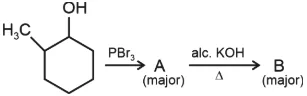
Major products A and B formed in the following , are
Options
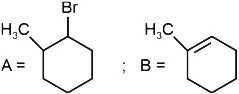
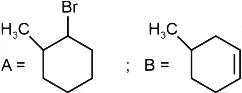
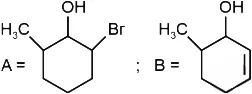
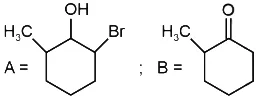
Correct Answer :
Solution :
Based on the reaction sequence shown in the images, the step-by-step conversion is as follows:
Step 1: Formation of Product A
The starting material shown in the reaction scheme is 2-methylcyclohexanol. When treated with phosphorus tribromide (), the hydroxyl group (-OH) is substituted by a bromine atom (-Br). This nucleophilic substitution reaction proceeds via an mechanism, replacing the -OH group with -Br to yield 1-bromo-2-methylcyclohexane as the major product A (shown in the first option image):
Step 2: Formation of Product B
When 1-bromo-2-methylcyclohexane (Product A) is heated with alcoholic KOH (), it undergoes dehydrohalogenation (elimination of HBr) via an E2 mechanism. Under these strongly basic and hot conditions, the hydroxide/ethoxide base abstracts a beta-proton from an adjacent carbon atom while the bromide leaving group departs.
There are two adjacent beta-carbons from which a hydrogen atom can be eliminated:
1. Elimination from the C-2 carbon (which holds the methyl group) yields 1-methylcyclohexene (a trisubstituted alkene).
2. Elimination from the C-6 carbon yields 3-methylcyclohexene (a disubstituted alkene).
According to Zaitsev's (Saytzeff's) rule, the major product of an elimination reaction is the more highly substituted, thermodynamically more stable alkene. Therefore, 1-methylcyclohexene is formed preferentially as the major product B:
Thus, the structures corresponding to A and B are:
A = 1-bromo-2-methylcyclohexane
B = 1-methylcyclohexene
Access expert-curated educational resources and study materials—completely free.
Create, conduct, and manage professional online assessments with Mindyard. Perfect for teachers and institutes.
Copyright © 2026 Mindyard. All Rights Reserved.