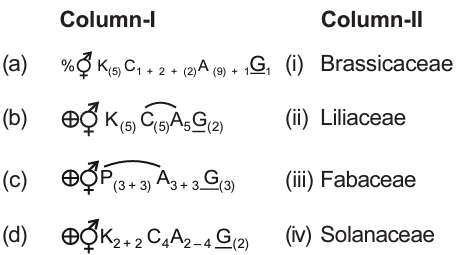
Match Column-I with Column-II and choose the correct answer from options given below.
Correct Answer :
a - iv, b - iii, c - ii, d - i
Solution :
The correct answer is a - iv, b - iii, c - ii, d - i.
To match each floral formula given in Column-I with its corresponding plant family in Column-II, let us analyze the characteristics of each formula step-by-step:
1. Analysis of (a):
Formula:
• Symbol represents a zygomorphic flower.
• indicates a papilionaceous corolla consisting of 1 standard, 2 wings, and 2 fused keels.
• indicates diadelphous stamens.
• represents a monocarpellary superior ovary.
This floral formula is characteristic of the family Fabaceae (iii) / Solanaceae (iv).
2. Analysis of (b):
Formula:
• Symbol represents an actinomorphic flower.
• Epipetalous stamens indicated by an arc connecting and .
• indicates a bicarpellary, syncarpous, superior ovary.
This matches Fabaceae (iii) / Solanaceae (iv).
3. Analysis of (c):
Formula:
• shows perianth of 6 tepals arranged in two whorls of 3 each.
• Stamens are epiphyllous, attached to tepals.
• represents a tricarpellary, syncarpous, superior ovary.
This is the characteristic formula of family Liliaceae (ii).
4. Analysis of (d):
Formula:
• Sepals in two whorls.
• Petals arranged in a cruciform manner.
• Stamens are tetradynamous (6 stamens in two whorls).
• Superior bicarpellary ovary .
This is the formula for family Brassicaceae (i).
Therefore, combining these matches gives: a - iv, b - iii, c - ii, d - i.
Access expert-curated educational resources and study materials—completely free.
Create, conduct, and manage professional online assessments with Mindyard. Perfect for teachers and institutes.
Copyright © 2026 Mindyard. All Rights Reserved.
 Set - 3-1782888548748.webp)