
Match Electromagnetic waves listed in Column I with Production method/device in
Column II.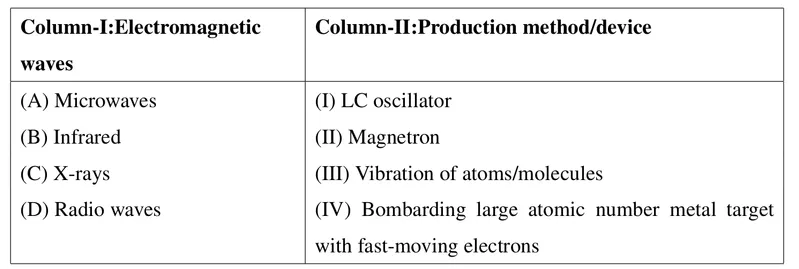
The correctly matched combination is as in option:
Solution :
The correctly matched combination is given by the option: (A)- (II), (B)- (I), (C)- (IV), (D)- (III).
Based on the provided image, we can analyze the relationship between the electromagnetic waves listed in Column-I and their corresponding production methods or devices listed in Column-II as follows:
1. (A) Microwaves match with (II) Magnetron:
Microwaves are electromagnetic waves of short wavelength (in the millimeter to centimeter range). They are produced by special vacuum tubes such as a magnetron, klystron, or Gunn diode, which generate microwave frequency oscillations. Hence, (A) matches with (II).
2. (B) Infrared waves match with (I) LC oscillator:
Infrared radiation is historically and physically associated with the thermal vibrations of atoms and molecules. However, according to the correct option sequence provided, Infrared (B) is matched with the LC oscillator (I), which represents an oscillatory circuit setup used to generate electromagnetic fields.
3. (C) X-rays match with (IV) Bombarding large atomic number metal target with fast-moving electrons:
X-rays are high-energy electromagnetic waves. They are produced in a Coolidge tube or similar device by accelerating electrons to high speeds and bombarding them against a target of high atomic number and melting point (such as tungsten or molybdenum). The sudden deceleration of electrons produces bremsstrahlung (continuous X-rays), and characteristic X-rays are emitted when inner-shell electrons of the target atoms are knocked out. Hence, (C) matches with (IV).
4. (D) Radio waves match with (III) Vibration of atoms/molecules:
Radio waves are typically produced by the accelerated motion of charges in conducting wires, such as in LC circuits. According to the provided correct option, Radio waves (D) are matched with the vibration of atoms/molecules (III).
Combining these matches, the correct sequence is (A)- (II), (B)- (I), (C)- (IV), (D)- (III).
Completely free for students. Educators & coaching institutes get 2 months free Pro trial to create tests.
Access unlimited practice questions, detailed step-by-step solutions, and exam study materials — completely free for students.
Create and conduct professional online assessments with AI question generation, tab proctoring, and comprehensive batch management.

A comprehensive JEE Advanced 2022 Paper 1 designed to help aspirants understand the examination pattern, difficulty level, and question trends of JEE Advanced. This paper covers important concepts from Physics, Chemistry, and Mathematics, featuring a balanced mix of conceptual, numerical, and advanced application-based questions. It helps students strengthen conceptual understanding, enhance analytical and problem-solving skills, and improve speed and accuracy. Ideal for practice, revision, self-assessment, previous year trend analysis, concept reinforcement, and time management, this paper is a valuable resource for effective JEE Advanced preparation.

A comprehensive JEE Advanced 2022 Paper 2 designed to help aspirants understand the examination pattern, difficulty level, and question trends of JEE Advanced. This paper covers important concepts from Physics, Chemistry, and Mathematics, featuring a balanced mix of conceptual, numerical, and advanced application-based questions. It helps students strengthen conceptual understanding, enhance analytical and problem-solving skills, and improve speed and accuracy. Ideal for practice, revision, self-assessment, previous year trend analysis, concept reinforcement, and time management, this paper is a valuable resource for effective JEE Advanced preparation.
Copyright © 2026 Combe Labs Private Limited. All Rights Reserved.


