Match List - I with List - II.
(a) 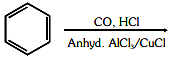 |
(i) Hell-Volhard-Zelinsky reaction |
(b)  |
(ii) Gattermann-Koch reaction |
(c)  |
(iii) Haloform reaction |
(d) 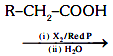 |
(iv) Esterification |
Choose the correct answer from the options given below.
Correct Answer :
(a)-(ii), (b)-(iii), (c)-(iv), (d)-(i)
Solution :
The correct answer is: (a)-(ii), (b)-(iii), (c)-(iv), (d)-(i)
Let us analyze each reaction shown in the images and match it with the correct named reaction from List-II.
Reaction (a): The image shows benzene reacting with CO, HCl in the presence of Anhydrous AlCl3/CuCl.
This is a classic formylation reaction where carbon monoxide and HCl act as the formylating agent, with anhydrous AlCl3 (a Lewis acid catalyst) and CuCl as co-catalyst, to introduce an aldehyde group (−CHO) onto the benzene ring, producing benzaldehyde.
This is the Gattermann-Koch reaction — a method for preparing aromatic aldehydes by treating an aromatic compound with CO and HCl in the presence of AlCl3 and CuCl.
∴ (a) → (ii) Gattermann-Koch reaction
Reaction (b): The image shows a compound with the structure R−CO−CH3 (a methyl ketone) reacting with NaOX (sodium hypohalite, where X = Cl, Br, or I).
When a methyl ketone (R−COCH3) is treated with a sodium hypohalite (NaOX), the methyl group adjacent to the carbonyl is trihalogenated, and the resulting trihalomethyl group (CX3) is cleaved off as a haloform (CHX3), leaving behind a carboxylate salt (RCOONa).
This is the Haloform reaction — a well-known reaction specific to methyl ketones and secondary alcohols of the type CH3−CH(OH)−R.
∴ (b) → (iii) Haloform reaction
Reaction (c): The image shows R−CH2−OH (a primary alcohol) reacting with R'COOH (a carboxylic acid) in the presence of Conc. H2SO4.
When an alcohol reacts with a carboxylic acid in the presence of concentrated sulphuric acid (which acts as a dehydrating agent and catalyst), an ester is formed along with water. This is a condensation reaction:
R−CH2−OH + R'COOH R'COOCH2R + H2O
This is the Esterification reaction — specifically Fischer esterification, where an acid and an alcohol combine to form an ester.
∴ (c) → (iv) Esterification
Reaction (d): The image shows R−CH2−COOH (a carboxylic acid with an α-hydrogen) reacting with (i) X2/Red P (halogen with red phosphorus) followed by (ii) H2O (hydrolysis).
When a carboxylic acid having an α-hydrogen is treated with a halogen (Cl2 or Br2) in the presence of red phosphorus (which generates the phosphorus trihalide PX3 in situ), halogenation occurs specifically at the α-carbon. The red phosphorus first converts the acid to an acyl halide, which then undergoes α-halogenation. Subsequent hydrolysis gives the α-halo carboxylic acid.
R−CH2−COOH → R−CHX−COOH
This is the Hell-Volhard-Zelinsky (HVZ) reaction — a reaction used for α-halogenation of carboxylic acids using Cl2 or Br2 in the presence of red phosphorus (or PBr3).
∴ (d) → (i) Hell-Volhard-Zelinsky reaction
Final Matching:
(a) ��� (ii) Gattermann-Koch reaction
(b) → (iii) Haloform reaction
(c) → (iv) Esterification
(d) → (i) Hell-Volhard-Zelinsky reaction
This corresponds to option: (a)-(ii), (b)-(iii), (c)-(iv), (d)-(i).
Access expert-curated educational resources and study materials—completely free.
Create, conduct, and manage professional online assessments with Mindyard. Perfect for teachers and institutes.
Copyright © 2026 Mindyard. All Rights Reserved.