Match List-I with List-II
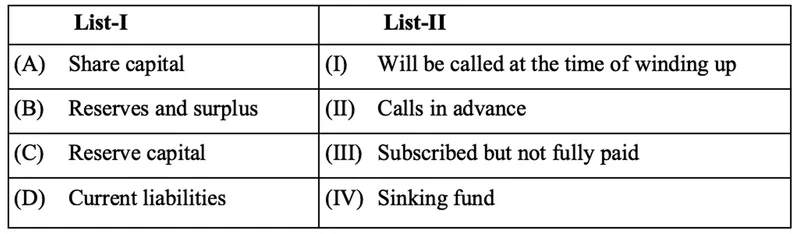
choose the correct answerfrom the options given below:
Correct Answer :
(A)- (I), (B)- (III), (C)- (II), (D)- (IV)
Solution :
The correct option is (A)- (I), (B)- (III), (C)- (II), (D)- (IV).
By analyzing the columns in the provided image, we can understand the relationship and matching between the accounting concepts in List-I and the descriptions in List-II:
1. (A) Share capital matches with (I) Will be called at the time of winding up:
Share capital is the funds raised by a company through issuing shares. Under company law, a company can reserve a portion of its uncalled share capital to be called up exclusively in the event of and for the purpose of winding up the company.
2. (B) Reserves and surplus matches with (III) Subscribed but not fully paid:
Reserves and surplus represent the accumulated profits and earnings retained by a company. In the equity section of a balance sheet, the presentation of reserves and surplus is structured alongside the share capital classifications, including the subscribed capital that is subscribed but not fully paid.
3. (C) Reserve capital matches with (II) Calls in advance:
Reserve capital is the part of capital that remains uncalled until winding up. On the other hand, calls in advance represent the amount paid by shareholders before the company makes a formal call. Both of these concepts represent different states of called and uncalled capital management.
4. (D) Current liabilities matches with (IV) Sinking fund:
Current liabilities are the short-term financial obligations of a company due within one year. A sinking fund is a specialized fund created by setting aside revenue to specifically pay off or redeem outstanding liabilities, serving as a financial mechanism to manage these obligations.
Access expert-curated educational resources and study materials—completely free.
Create, conduct, and manage professional online assessments with Mindyard. Perfect for teachers and institutes.
Copyright © 2026 Mindyard. All Rights Reserved.