Match List-I with List-II:
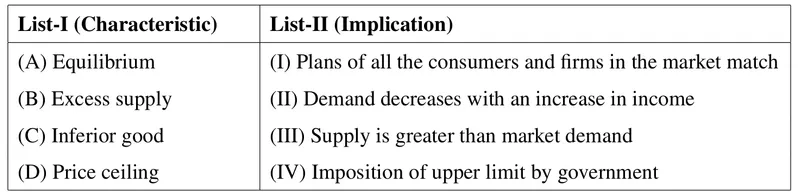
Choose from the options given below:
Correct Answer :
(A)- (I), (B)- (III), (C)- (II), (D)- (IV)
Solution :
The correct option is (A)- (I), (B)- (III), (C)- (II), (D)- (IV).
To understand why this match is correct, let us analyze each term listed in List-I (Characteristic) with its corresponding definition/implication in List-II (Implication) based on economic principles:
1. (A) Equilibrium matches with (I) Plans of all the consumers and firms in the market match
In economics, market equilibrium is a state where market forces such as supply and demand are balanced. At the equilibrium price, the quantity of a good that buyers want to buy (quantity demanded) is exactly equal to the quantity that sellers want to sell (quantity supplied). Therefore, the plans of all consumers (buyers) and firms (sellers) in the market align perfectly, resulting in no tendency for the price to change.
2. (B) Excess supply matches with (III) Supply is greater than market demand
Excess supply (also known as a surplus) occurs when the quantity supplied by producers at a given price exceeds the quantity demanded by consumers at that price. This imbalance exerts a downward pressure on the market price, pushing it back toward the equilibrium level.
3. (C) Inferior good matches with (II) Demand decreases with an increase in income
An inferior good is a type of good for which demand is inversely related to the consumer's income. When consumer income rises, they tend to substitute these cheaper goods with higher-quality or preferred alternatives (normal goods), causing the demand for the inferior good to decrease.
4. (D) Price ceiling matches with (IV) Imposition of upper limit by government
A price ceiling is a government-imposed regulatory measure that sets a legal maximum price (upper limit) that sellers can charge for a product or service. This is typically implemented to protect consumers by keeping essential goods affordable, and it is usually set below the market-clearing equilibrium price.
By combining these matches, we get:
(A) - (I)
(B) - (III)
(C) - (II)
(D) - (IV)
This perfectly matches the correct option.
Access expert-curated educational resources and study materials—completely free.
Create, conduct, and manage professional online assessments with Mindyard. Perfect for teachers and institutes.
Copyright © 2026 Mindyard. All Rights Reserved.