Match List-I with List-II:
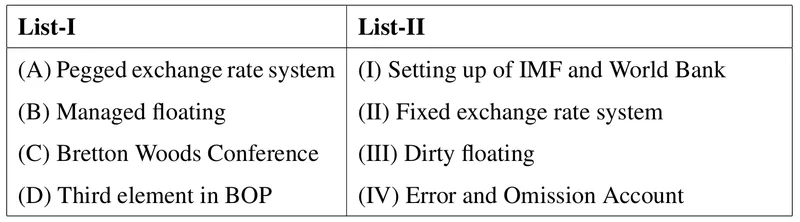
Choose from the options given below:
Correct Answer :
(A)- (II), (B)- (III), (C)- (I), (D)- (IV)
Solution :
The correct option is (A)- (II), (B)- (III), (C)- (I), (D)- (IV).
Here is the detailed step-by-step matching and explanation for each item in List-I and List-II:
1. (A) Pegged exchange rate system matches with (II) Fixed exchange rate system:
A pegged exchange rate system is a regime where a country's government or central bank anchors the value of its currency to another single currency (such as the US Dollar), a basket of other currencies, or a measure of value like gold. Because it actively maintains a set valuation, it is classified as a type of fixed exchange rate system.
2. (B) Managed floating matches with (III) Dirty floating:
Managed floating is an exchange rate regime where the currency value is largely determined by market demand and supply. However, the central bank occasionally intervenes in the foreign exchange market to buy or sell currencies to prevent extreme volatility or to keep the exchange rate within a desired range. Because of this intervention, it is colloquially and formally referred to as "dirty floating" (in contrast to "clean floating" where no intervention occurs).
3. (C) Bretton Woods Conference matches with (I) Setting up of IMF and World Bank:
The Bretton Woods Conference, officially known as the United Nations Monetary and Financial Conference, took place in July 1944. Its main objective was to rebuild the international economic system after World War II, which directly led to the establishment of the International Monetary Fund (IMF) and the International Bank for Reconstruction and Development (IBRD, now part of the World Bank).
4. (D) Third element in BOP matches with (IV) Error and Omission Account:
The Balance of Payments (BOP) is a comprehensive record of all economic transactions between residents of a country and the rest of the world. While the BOP must theoretically balance (sum to zero), statistical discrepancies occur in practice due to incomplete data and differences in timing. The "Errors and Omissions" account serves as the balancing third element (alongside the Current Account and Capital/Financial Account) to account for these discrepancies.
Access expert-curated educational resources and study materials—completely free.
Create, conduct, and manage professional online assessments with Mindyard. Perfect for teachers and institutes.
Copyright © 2026 Mindyard. All Rights Reserved.