Match List-I with List-II:
Choose the correct answer from the options given below:
Correct Answer :
(A)- (III), (B)- (II), (C)- (I), (D)- (IV)
Solution :
The correct option is (A)- (III), (B)- (II), (C)- (I), (D)- (IV).
To understand why this is correct, we can analyze the major works of each sociologist listed in List-I and match them to their respective publications in List-II:
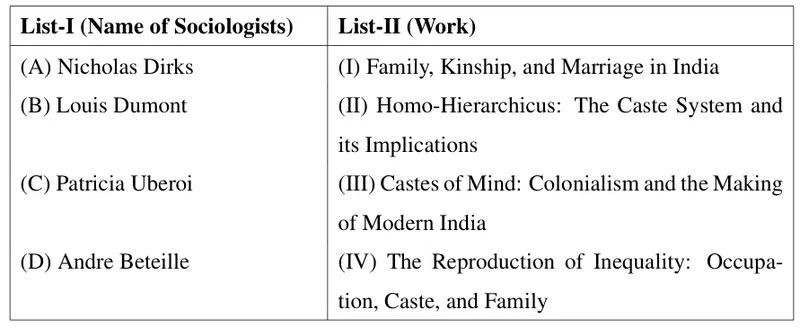
1. (A) Nicholas Dirks matches with (III) Castes of Mind: Colonialism and the Making of Modern India
Nicholas Dirks is an anthropologist and historian whose work focuses on the history of imperialism and colonialism. In his famous book Castes of Mind (2001), he argues that the caste system as we know it today in India is a modern phenomenon that was deeply shaped and standardized by British colonial rule, census operations, and administrative strategies.
2. (B) Louis Dumont matches with (II) Homo-Hierarchicus: The Caste System and its Implications
Louis Dumont was a French sociologist and anthropologist who wrote the seminal structuralist work on the Indian caste system, titled Homo-Hierarchicus (first published in 1966). Dumont posits that the caste system is based on a fundamental structural opposition between the pure and the impure, establishing a hierarchy that is distinct from western ideas of equality and stratification.
3. (C) Patricia Uberoi matches with (I) Family, Kinship, and Marriage in India
Patricia Uberoi is an eminent sociologist known for her extensive research on gender, family, kinship, and popular culture in India. She edited the highly regarded reader Family, Kinship, and Marriage in India (1993), which compiles key sociological and anthropological writings on the structure of kinship systems across different regions of India.
4. (D) Andre Beteille matches with (IV) The Reproduction of Inequality: Occupation, Caste, and Family
Andre Beteille is a renowned Indian sociologist known for his studies on caste, class, and social inequality. In his work The Reproduction of Inequality: Occupation, Caste, and Family (1991), he examines how social institutions like the family and occupation interact with traditional caste structures to reproduce and maintain socio-economic inequalities in modern India.
By matching these pairs, we get:
(A) ⇒ (III)
(B) ⇒ (II)
(C) ⇒ (I)
(D) ⇒ (IV)
Access expert-curated educational resources and study materials—completely free.
Create, conduct, and manage professional online assessments with Mindyard. Perfect for teachers and institutes.
Copyright © 2026 Mindyard. All Rights Reserved.