Match List-I with List-II:
Choose the correct answer from the options given below:
Correct Answer :
(A)- (IV), (B)- (III), (C)- (II), (D)- (I)
Solution :
The correct option is (A)- (IV), (B)- (III), (C)- (II), (D)- (I).
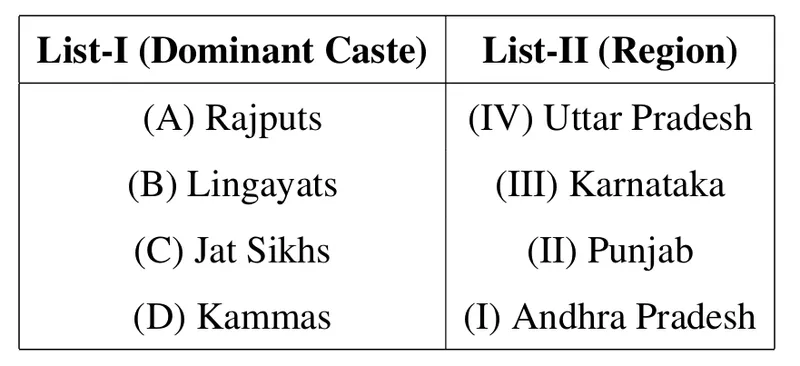
Based on the table provided in the image, we have two columns:
1. List-I (Dominant Caste): containing (A) Rajputs, (B) Lingayats, (C) Jat Sikhs, and (D) Kammas.
2. List-II (Region): containing (IV) Uttar Pradesh, (III) Karnataka, (II) Punjab, and (I) Andhra Pradesh.
The sociological concept of a "dominant caste," formulated by M. N. Srinivas, refers to a caste that dominates a specific region through numerical strength, political power, and ownership of a significant share of land. Let us examine the regional dominance of each caste listed:
- (A) Rajputs matches with (IV) Uttar Pradesh: Rajputs are a traditionally land-owning and politically influential community across North India, holding dominant positions in states like Rajasthan and Uttar Pradesh.
- (B) Lingayats matches with (III) Karnataka: The Lingayats are a major community and a powerful dominant caste in Karnataka, holding substantial agricultural land and exercising considerable political influence in the state.
- (C) Jat Sikhs matches with (II) Punjab: Jat Sikhs are the pre-eminent agrarian community in Punjab, representing the dominant land-owning class and a major political force in the region.
- (D) Kammas matches with (I) Andhra Pradesh: Kammas are an influential, prosperous agricultural and entrepreneurial community, representing one of the major dominant castes in Andhra Pradesh.
Thus, matching the dominant castes in List-I with their respective regions in List-II yields:
(A) - (IV)
(B) - (III)
(C) - (II)
(D) - (I)
Access expert-curated educational resources and study materials—completely free.
Create, conduct, and manage professional online assessments with Mindyard. Perfect for teachers and institutes.
Copyright © 2026 Mindyard. All Rights Reserved.