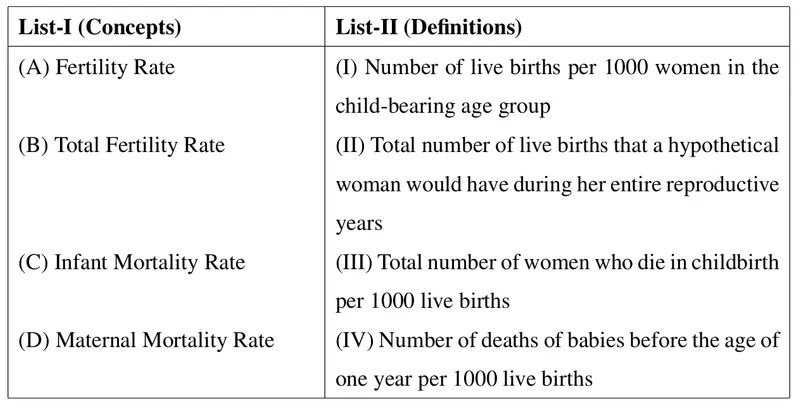
Match the following concepts (List-I) with their appropriate description (List-II):
Choose the correct answer from the options given below:
Correct Answer :
(A)- (I), (B)- (II), (C)- (IV), (D)- (III)
Solution :
The correct answer is (A)- (I), (B)- (II), (C)- (IV), (D)- (III).
By analyzing the columns in the provided image, we can systematically match each demographic concept from List-I (Concepts) to its correct definition in List-II (Definitions):
1. (A) Fertility Rate matches with (I):
The fertility rate (specifically the General Fertility Rate) is a standard demographic measure representing the number of live births per 1000 women of child-bearing age (typically defined as ages 15 to 49) in a population. Thus, (A) matches with (I).
2. (B) Total Fertility Rate matches with (II):
The Total Fertility Rate (TFR) is a projection that represents the average number of live births a hypothetical woman would have over the course of her entire reproductive life if she were to survive from birth to the end of her reproductive years and experience the age-specific fertility rates of a given period. Thus, (B) matches with (II).
3. (C) Infant Mortality Rate matches with (IV):
The Infant Mortality Rate (IMR) measures the probability of a child dying before their first birthday. It is calculated as the number of deaths of babies under one year of age per 1000 live births. Thus, (C) matches with (IV).
4. (D) Maternal Mortality Rate matches with (III):
The Maternal Mortality Rate measures female deaths associated with pregnancy and childbirth complications. In this context, it is described as the total number of women who die in childbirth per 1000 live births. Thus, (D) matches with (III).
Combining these individual matches, we get:
(A) - (I), (B) - (II), (C) - (IV), (D) - (III)
Access expert-curated educational resources and study materials—completely free.
Create, conduct, and manage professional online assessments with Mindyard. Perfect for teachers and institutes.
Copyright © 2026 Mindyard. All Rights Reserved.