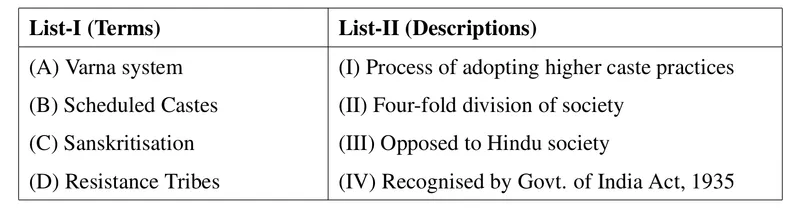
Match the following terms (List-I) with their description (List-II):
Choose the correct answer from the options given below:
Correct Answer :
(A)- (II), (B)- (IV), (C)- (I), (D)- (III)
Solution :
The correct option is (A)- (II), (B)- (IV), (C)- (I), (D)- (III).
To understand why this match is correct, let's break down each term from List-I and match it with its corresponding description in List-II based on sociological and historical concepts:
1. (A) Varna system matches with (II) Four-fold division of society:
The traditional Varna system is a social classification described in ancient Indian texts, which divides society into four hierarchical categories (varnas): Brahmins (priests and teachers), Kshatriyas (warriors and rulers), Vaishyas (merchants and agriculturists), and Shudras (laborers and service providers). Therefore, (A) matches with (II).
2. (B) Scheduled Castes matches with (IV) Recognised by Govt. of India Act, 1935:
Historically, the term "Scheduled Castes" was officially defined and introduced into legal terminology through the Government of India Act of 1935 to list down the castes that had historically suffered from social and economic exclusion. Therefore, (B) matches with (IV).
3. (C) Sanskritisation matches with (I) Process of adopting higher caste practices:
Sanskritisation is a sociological term popularized by M. N. Srinivas. It refers to the process by which castes placed lower in the caste hierarchy attempt to raise their social status by adopting the customs, rituals, beliefs, lifestyle, and practices of a dominant or "twice-born" (higher) caste. Therefore, (C) matches with (I).
4. (D) Resistance Tribes matches with (III) Opposed to Hindu society:
Certain tribal communities and groups historically resisted assimilation into the caste-structured Hindu society, retaining their independent cultural identity, social structures, and autonomy in opposition to mainstream Hindu societal norms. Therefore, (D) matches with (III).
By compiling these matches, we get:
(A) - (II)
(B) - (IV)
(C) - (I)
(D) - (III)
This perfectly matches the chosen option.
Access expert-curated educational resources and study materials—completely free.
Create, conduct, and manage professional online assessments with Mindyard. Perfect for teachers and institutes.
Copyright © 2026 Mindyard. All Rights Reserved.