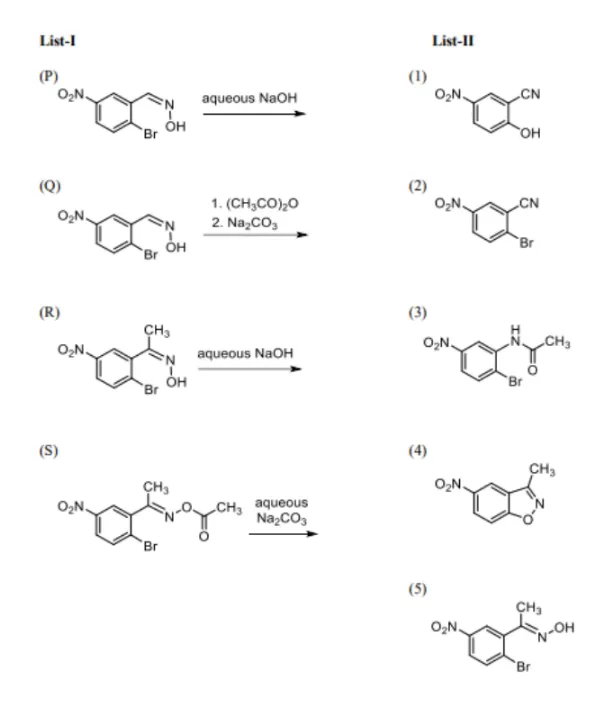
Match the major products obtained in the reactions given in List-I with the corresponding structures in List-II and choose the correct option.
Correct Answer :
P → 2; Q → 1; R → 5; S → 4
Solution :
Correct Answer: P → 2; Q → 1; R → 5; S → 4
Let us analyze each reaction given in List-I step-by-step by examining the reactant structure, reagents, and corresponding mechanism to identify the major products in List-II.
1. Reaction (P):
Reactant (P) is an aldoxime: 2-bromo-5-nitrobenzaldehyde oxime.
Reagent: aqueous NaOH
Mechanism: Hydroxide ion (OH-) acts as a base and deprotonates the oxime hydroxyl proton (-OH), forming an oximate anion. This promotes elimination of water (dehydration of the aldoxime) to yield a nitrile group (-CN). Under these conditions, the bromine atom at the ortho position remains unattacked or dehydration is the primary pathway yielding 2-bromo-5-nitrobenzonitrile.
Therefore, reaction (P) corresponds to structure (2).
2. Reaction (Q):
Reactant (Q) is the same aldoxime: 2-bromo-5-nitrobenzaldehyde oxime.
Reagents: 1. (CH3CO)2O (acetic anhydride) followed by 2. Na2CO3
Mechanism: Acetic anhydride acylates the -OH group of the oxime to form an oxime acetate (-O-COCH3). Upon treatment with base, it undergoes elimination of acetic acid to form the nitrile (-CN). Concurrently or sequentially, nucleophilic aromatic substitution (SNAr) occurs at the activated ortho position (activated by the strongly electron-withdrawing -NO2 and -CN groups), replacing the bromine atom (-Br) with a hydroxyl group (-OH).
Therefore, the major product is 2-hydroxy-5-nitrobenzonitrile, which corresponds to structure (1).
So, reaction (Q) corresponds to structure (1).
3. Reaction (R):
Reactant (R) is a ketoxime: 1-(2-bromo-5-nitrophenyl)ethan-1-one oxime.
Reagent: aqueous NaOH
Mechanism: Ketoximes lack an acidic aldoxime CH proton for elimination to form nitriles. Under mild aqueous NaOH treatment without a strong activating reagent/acid catalyst for Beckmann rearrangement or intramolecular cyclization, the ketoxime does not react significantly and is recovered unchanged (or remains as the ketoxime structure).
Thus, reaction (R) matches the unreacted/original ketoxime structure shown in (5).
So, reaction (R) corresponds to structure (5).
4. Reaction (S):
Reactant (S) is the O-acetylated derivative of the ketoxime: 1-(2-bromo-5-nitrophenyl)ethanone O-acetyl oxime.
Reagent: aqueous Na2CO3
Mechanism: The acetate group (-OCOCH3) is a good leaving group. Deprotonation or intramolecular nucleophilic displacement by the oxime oxygen or intramolecular attack by the aromatic ring oxime derivative leads to intramolecular displacement of bromine (intramolecular SNAr cyclization), forming a 1,2-benzisoxazole derivative (specifically 3-methyl-5-nitrobenzo[c]isoxazole / 3-methyl-5-nitroisoxazole ring system).
Therefore, reaction (S) yields the cyclic product corresponding to structure (4).
Matching Summary:
• P → 2
• Q → 1
• R → 5
• S → 4
Access expert-curated educational resources and study materials—completely free.
Create, conduct, and manage professional online assessments with Mindyard. Perfect for teachers and institutes.
Copyright © 2026 Mindyard. All Rights Reserved.